
Analysis of Hymn Among The Ruins
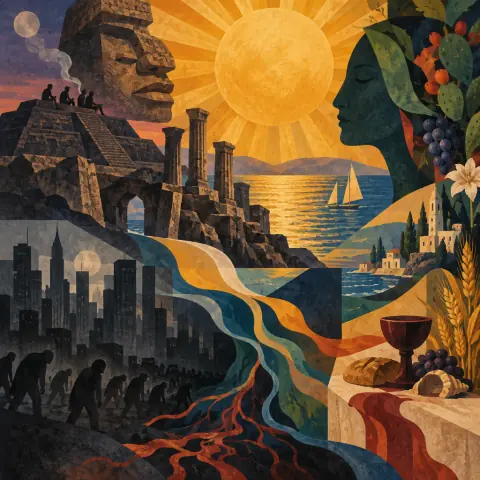
Midday’s Promise of Wholeness
The poem tries to recover a living unity from a world divided by history, modern violence, and the speaker’s own fractured thought. Its governing opposition is announced in the title: a hymn is a song of praise, while ruins testify to collapse. Paz refuses to choose between them. Ruins can remain alive
, and the radiant day can contain intimations of blood. The poem’s praise of existence is therefore neither innocent nor serene. It asks whether the senses, language, and imagination can transform a damaged world without concealing its damage.
The opening makes daylight seem sovereign and self-generating. The day is self-crowned
, its brightness a shout tall and yellow
. Sea, mountain, goats, and sun become startlingly fluid: the sea is a spider, goats turn into stones, and the sun lays a golden egg. These transformations culminate in the ecstatic declaration All is god
. Divinity here is not situated beyond the visible world; it appears through the world’s changing forms. That is why appearances possess a momentary truth
. Their transience does not make them false. A form is true precisely while light brings it fully into presence.
Ruins That Refuse to Die
Yet the opening vision already contains injury. The mountain bears a livid wound
, and the columns are gnawed by the light
. Illumination reveals beauty, but it also erodes what it touches. The phrase death in life
names the poem’s central contradiction: vitality and destruction are not separate conditions but simultaneous aspects of existence. The broken statue and damaged columns belong to the hymn because their decay makes time visible. Light does not restore the ancient world; it gives the remains an intense, temporary life.
This tension becomes historical at Teotihuacán. Night replaces the opening midday, and the sacred pyramid is occupied by boys smoking marijuana while harsh guitars sound
. The scene is not simply a complaint about modern irreverence. The boys retain a hunger for altered consciousness, music, and communal intensity, but they have inherited monumental forms whose meaning is no longer readily available. Accordingly, the speaker asks where to recover the word
capable of joining hymn to speech, dance to city, and spiritual order to the measuring scales
of public life. His desire is not for archaeological revival. He wants a language that could reconnect worship, art, society, and justice in the present.
Mexico’s Song Becomes a Barrier
The answer does not come easily. Instead, The song of Mexico
explodes as a curse and then hardens into a stone
blocking contact. Song should connect voices, but here national identity becomes an enclosure. The colored star
briefly flares and then goes out, suggesting that cultural brilliance alone cannot sustain communion. Even the earth has become self-corrupted: it tastes of rotten earth
. The repetition makes the decay feel inescapable, as though the country were feeding upon its own exhausted substance.
Against this blockage, the poem turns back to physical immediacy: Eyes see, hands touch
. Food and landscape offer a modest, sensuous alternative to abstraction—figs, grapes, clams, salt, cheese, wine, and bread. These objects carry sacred suggestions without ceasing to be ordinary nourishment. Grapes taste of resurrection, and bread belongs to the sun rather than to a remote heaven. The island girl likewise becomes a slim cathedral
; the sacred is embodied in a human figure, while light itself builds temples on the sea
. The earlier search for buried words gives way to available things. A few tangible forms may be enough to begin rebuilding relation.
Polyphemus Above the Modern Pits
That recovered harmony is abruptly challenged by New York, London, Moscow
. By naming capitalist, imperial, and communist centers together, the poem refuses to locate dehumanization within a single political system. All three belong to a modern landscape covered by diseased shadow, rats, and an anemic sun
. The brightness that crowned the opening day can barely survive here.
Polyphemus, the man-eating Cyclops, yawns above mountains that were once cities, while below him human beings drag themselves like a herd. The parenthetical description of people as Domestic bipeds
adopts the cold vocabulary of classification and consumption. Human flesh is said to be prized by the wealthy, turning economic exploitation into literal cannibalism. The joke is savage: modern society may prohibit certain kinds of meat on religious grounds while permitting powerful classes to consume human lives. Civilization’s supposed progress has recreated the monster of myth on an industrial scale.
Wine, Blood, and the Fulfilled Moment
The speaker nevertheless returns to his discipline of seeing and touching. He stretches his senses toward this living hour
, seeking a moment in which scattered forms achieve a yellow harmony
. But the vision has changed. A wine stain smells of blood, so pleasure cannot be purified of historical suffering. Coral branching through water becomes an image of the senses reaching outward, yet it also resembles veins or a spreading wound. Midday is both an ear of wheat
, promising nourishment, and eternity’s brimming cup
, suggesting that a single temporal instant can hold something larger than time.
The poem’s deepest crisis follows this fulfillment rather than preceding it. The speaker’s thoughts split, tangle, restart, and become endless rivers
that finally form a delta of blood
. Consciousness cannot simply remain within sensuous harmony; it remembers ruins, curses, devoured cities, and exploited bodies. His question—whether everything must end in stagnant water—reveals the fear that all movement, including poetic thought, may terminate in paralysis. The hymn risks becoming another failed current.
From Flowers into Deeds
The final stanza answers that fear with an act of imaginative reconciliation. Day returns as a complete orange divided into four-and-twenty bars
: time is segmented into hours but remains one fruit, one sweetness. This is the poem’s final model of unity—not the elimination of difference, but the gathering of divisions into a whole. Thus the two hostile become one
, and the rigid mirror of consciousness liquefies into a fountain. The mind ceases merely to reflect a broken world and becomes capable of generating forms.
The conclusion also raises the stakes of poetry. Man is called a tree of images
, but images are not the endpoint. Words flower, flowers become fruit, and fruits become deeds. The sequence insists that language must ripen into action if the hymn is to overcome the stone blocking human contact. Paz does not prove that such transformation will occur; the leap from words to deeds remains visionary and precarious. Yet the poem itself performs the first part of that labor, holding sunlight and blood, sacred ruins and modern pits, Mexico and the wider world within one difficult song.
Feel free to be first to leave comment.