
Analysis of Sunstone
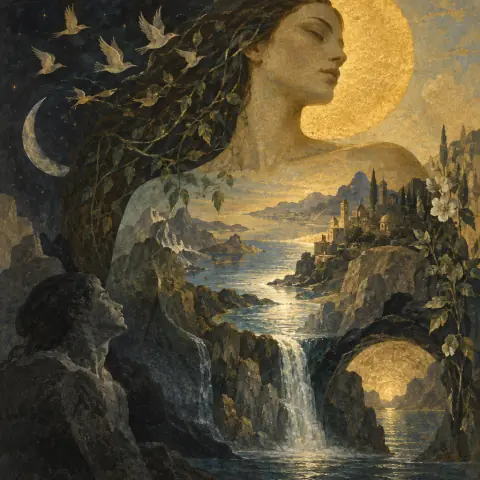
The river that arrives forever
Sunstone imagines love as an entrance into cyclical time: through the beloved’s body, the speaker briefly escapes his isolated self and experiences birth, death, desire, and renewal as parts of one continuous movement. Its opening images are built from apparent contradictions. The willow is made of crystal, the poplar of water; the tree is both firmly rooted
and dancing. Likewise, the river advances and retreats while arriving forever
. Nothing here is fixed, yet nothing simply disappears. Being alive means changing while remaining within a larger rhythm.
The poem’s circular movement reinforces that vision. Its final lines return almost exactly to the opening willow, fountain, tree, and river. This return is not mere repetition: after the speaker has passed through erotic union, dismemberment, death, and awakening, the original images carry a fuller meaning. The river’s roundabout course has become the poem’s model of time itself. Arrival is not a final destination but a continual return to presence.
A body through which the world becomes visible
At first, the beloved appears as an intense concentration of reality. Her presence resembles both singing and wind in a burning building
, combining beauty with danger. Light acquires anatomy—thighs, belly, and body—until the world becomes visible through her. She is not merely compared with nature; she becomes the medium through which nature can be perceived. The speaker’s claim that the world is transparent through your transparency
suggests that erotic attention strips away ordinary separations between person and landscape.
This merging becomes more intimate as he travels through her body as though through a city, river, grove, or mountain path. Her belly is the city’s sunlit center; her breasts are churches; her eyes are water where tigers drink their dreams. The tone is ecstatic and exploratory, but the speaker is not simply possessing the beloved. He repeatedly loses control of himself: mirrors cancel him, her thoughts become a narrow road, and his spirit finally flings itself down
and shatters. Desire promises union precisely by breaking apart the stable identity of the person who desires.
Water that nourishes and erases
Water is the poem’s most persistent substance. It forms the opening trees, the beloved’s loins, mouth, fingers, and hair, and finally the roots of a liquid tree
growing inside the speaker. Water joins bodies because it crosses boundaries and takes the shape of whatever contains it. The erotic encounter therefore feels like immersion: he swims through her eyes and voyages through her waist.
Yet water also threatens the distinction between self and other. When the beloved closes his eyelids with her mouth of water
, tenderness resembles drowning. The speaker wants release from his confined identity, but that release may also mean annihilation. This is one of the poem’s central tensions: intimacy can gather a fragmented person together, yet it does so by dissolving the borders that make that person separate.
The beloved turns toward death
Midway through the poem, the beloved’s transformations grow darker. She becomes the edge of a sword, an executioner’s bowl, venom, a thorn, and salt rubbed in the wound
. The earlier natural abundance has not vanished; flowers, grapes, jasmine, wheat, and pomegranate remain beside images of injury and death. The beloved is now less an individual woman than a contradictory sacred power: queen and wound, nourishment and poison, resurrection and grave.
This is the poem’s major turn. Erotic praise becomes invocation. The speaker addresses her as lady of midnight
, empress of daybreak
, and the world’s flesh as well as the house of death
. These opposites are not resolved by choosing one over the other. Instead, the poem insists that life and death
are reconciled in the same figure. The beloved gives immortal pain because desire exposes mortality: to love a body intensely is also to recognize that it can be wounded, lost, and buried.
A prayer from the scattered self
Once the beloved assumes this double power, the speaker’s voice becomes openly pleading. He describes himself as endlessly falling inward, unable to touch his own depth. He asks her to gather his scattered dust
, make peace among his ashes, and bind his dismembered bones. The language suggests that isolation is a form of inner dismemberment. His intellect has turned against itself, leaving him divided into thought, body, memory, and desire.
What he asks from love is therefore more than pleasure. He asks to be brought to earth in your earth
: restored to embodiment, mortality, and connection. The beloved is a gateway because another person can interrupt the closed circuit of the self. But the poem also turns the command outward—open your being
, awaken, carve your face. Love requires mutual recognition. Each person must look fully at the other, and that gaze must include death rather than disguising it.
From facelessness to dawn
The poem pushes toward a paradoxical destination: individual faces dissolve into a nameless face
, yet this dissolution produces presence rather than emptiness. A face ordinarily marks personal identity, but Paz imagines the deepest encounter as something larger than identity—an existence shared among sea, bread, rock, fountain, and human beings. The self becomes most alive when it stops treating itself as sealed and self-sufficient.
Even then, transcendence is not easy. The abrupt admission I cannot
interrupts the visionary confidence. The moment scatters into separate things, and the speaker falls back into the sleep of stone. Yet this obstruction becomes the condition of awakening: barriers collapse, sunlight enters his forehead, and his closed eyelids open. The sun does not merely illuminate him; it uproots him from the centuries-long inertia of the isolated self.
The return that changes everything
The closing return to the crystal willow and curving river completes the poem’s argument. Nothing has been permanently conquered: death remains within life, fragmentation within love, and stillness within movement. But the speaker has learned to perceive these contradictions as one rhythm. The final tone is renewed rather than triumphant. Like the river that advances, retreats, and circles, consciousness must repeatedly awaken from its stony sleep.
Thus Sunstone does not promise escape from time; it transforms time from a path toward extinction into a cycle of encounter and rebirth. The beloved’s body opens that cycle because it is at once earthly and cosmic, vulnerable and regenerative. To be arriving forever
is never to possess eternity once and for all. It is to enter the world again—through desire, loss, another face, and the returning light.
Feel free to be first to leave comment.