
Hymn
At morn- at noon- at twilight dim- Maria! Thou hast heard my hymn! In joy and woe- in good and ill- Mother of God, be with me still! When the hours flew brightly by, and not a cloud obscured the sky, my soul, lest it should truant be, thy grace did guide to thine and thee; Now, when storms of Fate o'ercast darkly my Present and my Past, let my Future radiant shine with sweet hopes of thee and thine!
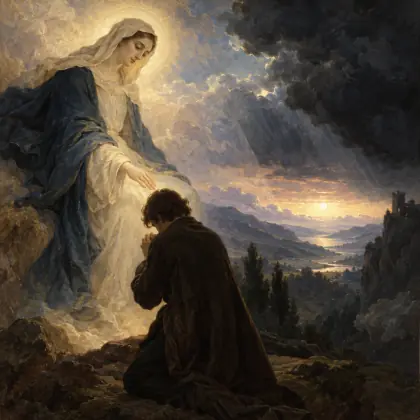
Hymn - context Summary
Published 1829 as a Hymn
Edgar Allan Poe’s "hymn" was published in 1829 in the collection Al Aaraaf, Tamerlane and Minor Poems and functions as a brief devotional address to Maria, the Mother of God. The poem stages prayer across daily times and life’s phases—morning, noon, twilight; past, present, future—pleading for continual guidance, protection, and hopeful promise. Its occasion is explicitly religious devotion, and its clear labeling as a hymn directs readers to hear it as liturgical supplication rather than narrative lyric, emphasizing consolation through faith amid joy and trouble.
Feel free to be first to leave comment.