
Analysis of The Alpaca
The Fantasy of Perfect Preparedness
Gabriela Mistral begins by presenting the alpaca as an animal prepared for every possible demand. She is harnessed for a long journey
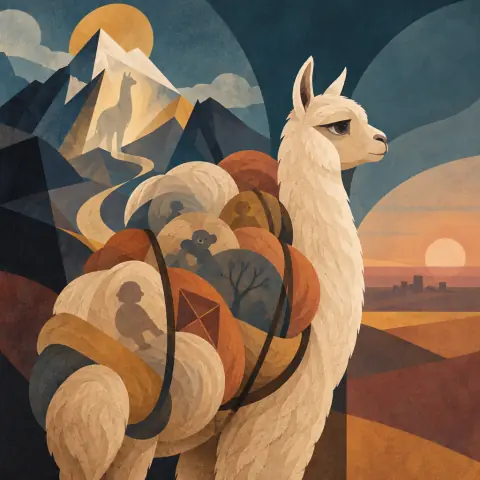
, and her body carries what looks like an inexhaustible supply: an entire store of wool
. Yet this readiness is not freedom or strength. The merchant has failed to collect her, but she remains harnessed, waiting for work that may never begin. The poem’s central tension is that what humans praise as abundance is experienced by the alpaca as an unexplained burden. Her usefulness has been turned into a permanent condition.
Softness That Conceals the Body
The alpaca’s wool makes her seem almost miraculous. A newborn placed on her back would not feel a bone
; the living animal disappears beneath her softness. That image is tender, but also disturbing. Her body is valued because it can cushion another body, while her own discomfort remains hidden. Even the shearing scissors become an unexpected kindness: in the heat, blades that will cut and cut
represent mercy. The phrase joins violence and relief. The instrument used to harvest the alpaca’s value is also the only thing capable of freeing her from the value she has accumulated.
The Storehouse of Lost Things
The middle of the poem expands the alpaca from a wool-bearing animal into a figure from children’s imagination. She seems to carry everything that has gone missing: dolls, teddy bears, flying rats
, and even trees with seven voices
. The list mixes familiar toys with impossible creatures, making her back into a secret world where loss can be reversed. To the children, she is an infinitely prepared companion
, a comforting answer to absence.
But this fantasy also repeats the adults’ mistake. Merchant and child alike imagine the alpaca as a container rather than a creature. The merchant sees stored wool; the children see stored wonders. Both place their needs on her back. Her apparent magical capacity becomes another reason not to ask what she herself wants.
The Astonished Eyes
The decisive turn comes with the command, But look at those eyes
. The poem interrupts its own playful invention and returns to the animal’s bewilderment. Her eyes are astonished
and without knowledge
; she does not understand why she has been prepared for a journey or why nobody relieves her. This ignorance is not stupidity. It exposes the absurdity of the human arrangement. The alpaca cannot understand because there is no satisfying explanation for being burdened, forgotten, and expected to remain ready.
Her gaze also changes the poem’s tone. What began as affectionate whimsy becomes an accusation. The repeated emphasis on looking asks readers to stop admiring the wool and notice the consciousness beneath it. The tragedy is not merely that the alpaca carries too much, but that others interpret her patience as consent.
The Mountain as Mother
In the final movement, the Andean plateau becomes part of the alpaca’s family. The mother alpaca stares toward the mountain, which is itself casting off burdens
until its summit becomes clear. The mountain resembles an immense older alpaca shedding a pack in the heights. This identification binds animal and landscape together: both carry coverings, both release them, and both belong to the high Andean world.
Once the alpaca is taken down from the plateau, she faces a nonsensical horizon
. The horizon is nonsensical because it offers no recognizable relationship among animal, mountain, and sun. Turning her neck, she searches for the older alpaca
that remains above. Her displacement is therefore more than geographical. She has been removed from a landscape that gave meaning to her body and placed in a world that sees that body chiefly as merchandise, shelter, or storage.
A Question That Misplaces Guilt
The closing question asks what the speaker and the alpaca have done to the Andean cordillera. Its use of we is deliberately uneasy. Human beings may have altered, exploited, or abandoned the mountain world, but what has the alpaca done except carry what was placed upon her? By including the innocent animal in the question, the speaker reveals how readily guilt itself can become another burden assigned to the burdened.
The poem finally turns the alpaca into both companion and witness. She carries wool, lost toys, human fantasies, and perhaps human remorse, yet her astonished eyes continue to ask for an explanation. Mistral leaves that demand unanswered because the failure belongs not to the animal but to the world that harnesses her, admires her softness, and forgets to set her free.
Feel free to be first to leave comment.