
Analysis of The Lark
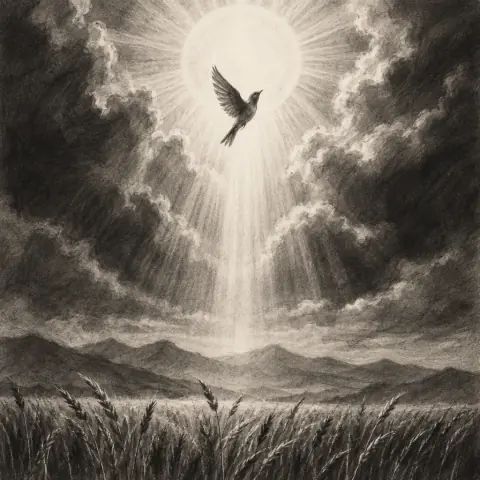
The dream of a straight ascent
The poem turns the lark’s flight into an image of spiritual aspiration: the desire to move directly from ordinary earthly life toward illumination. Addressing Francis, the speaker recalls his preference for the lark because of its straight flight toward the sun
. She wanted their shared movement to have the same directness. Yet the poem gradually admits that human beings rarely live this way. They remain attached to habit, physical limitation, and self-importance. Its central tension lies between the soul’s longing for vertical ascent and the body’s tendency to remain in familiar ruts
.
Birds that remain near the world
The albatrosses and storks provide beautiful but insufficient alternatives. Albatrosses move above the sea like unfettered waves
, yet they still imitate and remain connected to the water below. Storks undertake enormous journeys and cast shadows over the Earth, but their flight is horizontal, interrupted by rest in the hills. Both birds possess freedom and grandeur, though neither escapes the world’s plane. Their movement extends across the Earth rather than away from it. The distinction is not between confinement and freedom, then, but between two kinds of freedom: roaming widely within earthly existence and rising beyond its limits.
The lark between Earth and sun
The lark alone breaks the pattern. It leaps out of ruts
like a dart and is swallowed by the heavens
. Its ascent is so forceful that the boundary between bird and world becomes uncertain: the sky seems to receive a piece of the Earth itself. Neither jungles nor mountains answer its upward call. Even the mountains, normally symbols of height, appear crucified over the flatlands
, fixed in place despite their elevation. The lark’s smallness therefore becomes part of its power. It rises more truly than the massive landscape because it is alive, mobile, and directed.
At the peak of its flight, the bird exists between the two
, neither clearly descending from the sun nor ascending from the ground. Compared to a flame and a winged arrow
, it joins upward motion with burning intensity. Its song also matters: ascent is not silent self-purification but an act of abundance, something poured into the heavens. Still, the lark eventually returns exhausted to the wheatfield. This landing complicates the symbol. Even the creature that appears to overcome gravity cannot remain aloft; earthly return is built into its flight.
Francis’s golden multitude
When the speaker returns to Francis, the solitary bird becomes a collective vision. He imagined the morning filled with airborne arrows and a net of golden larks
between Earth and sky. The apparent contradiction in that image is revealing: a net usually traps, but this net is made of liberated creatures. Francis’s ideal seems to be a community held together not by restraint but by shared aspiration. The desired haven
is also paradoxical. They must fly upward to reach a place where they can finally rest in the light
; strenuous transcendence promises perfect repose.
The confession of the rut
The decisive turn comes with the blunt admission, We are burdened, Francis
. The earlier bird imagery now becomes an accusation against human conduct. People do not merely suffer their routines; they cherish
them. They also mistake ordinary ambition for spiritual ascent. The grass that strains upward may seem lofty, but even its tallest blade cannot pass the pines. Earthly glory resembles vertical flight while remaining rooted in comparison, pride, and limitation.
The ending gives the lark’s ascent a darker meaning. Only death, the speaker claims, releases the soul from bodily inhibition and makes true vertical flight possible. This conclusion is both hopeful and severe: the desired union with light exists, but human beings cannot fully achieve it while alive. The lark therefore embodies an aspiration that life can imitate only briefly. Its return to the wheatfield anticipates human exhaustion, while its vanishing into heaven anticipates the final release from the rut. The poem begins with an ideal of shared flight and ends by acknowledging the cost of making that ideal absolute.
Feel free to be first to leave comment.