
Analysis of Rocking
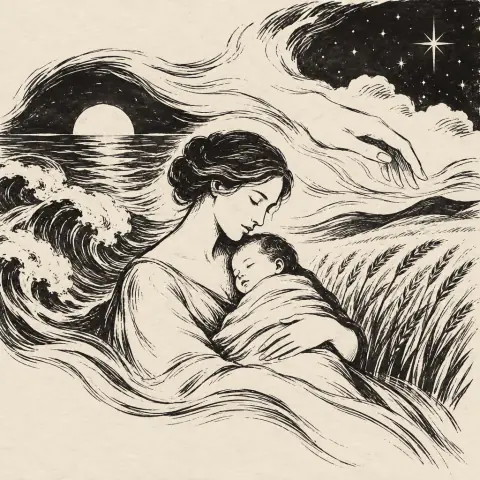
The World as a Cradle
The poem presents a mother’s act of rocking her child as part of a vast, sacred motion already taking place throughout creation. What begins as an ordinary lullaby expands outward to include sea, wind, fields, worlds, and God. Yet the expansion does not make the mother seem insignificant. Instead, her small repeated gesture becomes the human form of a universal tenderness: she rocks her son because the whole world is also rocking what it holds.
Learning from Sea and Wind
The first two stanzas connect maternal care to natural rhythms. The sea rocks its thousand waves
, while the wandering wind rocks the night fields of wheat
. Both images involve many separate things moving together: individual waves belong to one sea, just as individual stalks of wheat belong to one field. The child likewise remains a distinct life while being held within something larger—the mother’s body, attention, and love.
The speaker does not merely observe these movements; she listens to them. She hears the loving seas
and then the loving winds
. Calling these immense, impersonal forces loving changes their character. The sea is not dangerous here, and the wandering wind is not restless or cold. Their ceaseless movement becomes protective. The mother seems to receive instruction or reassurance from them: hearing how nature cradles its own children, she continues to rock hers.
From Audible Nature to Silent God
The poem’s main turn comes in the final stanza. Sea and wind can be heard, but Silent God Father
cannot. The speaker therefore shifts from hearing to feeling: I feel His hand
. This movement from sound to touch makes the ending more inward and mysterious. God’s care is not announced; it is sensed in shades
, a word that suggests night, obscurity, shelter, and perhaps the limits of human understanding.
The scale also changes dramatically. The sea holds thousands of waves, but God rocks His thousands worlds
. The mother’s cradle song now reaches beyond the earth. Nevertheless, each stanza ends with the same intimate words, my son, my son
. The repetition resists being overwhelmed by the cosmic vision. However many worlds God holds, this particular child remains precious and immediate to the speaker.
A Mother Both Holding and Held
A central tension runs through the poem: the mother appears to be the active comforter, yet she is also surrounded by powers that comfort her. She rocks her son, but the sea, wind, and God establish the rhythm she follows. Her care is therefore both personal and borrowed. She gives love while feeling herself enclosed within a greater love.
The description of God as Father might seem to place divine authority above maternal tenderness, but the poem quietly makes the mother’s action the clearest image of what divine care means. God’s hand rocking worlds becomes understandable because she is rocking a child. The poem’s deepest claim is not simply that motherhood resembles creation; it is that creation itself may be imagined as parental care—immense, repetitive, silent, and gentle enough to be felt in the darkness.
Feel free to be first to leave comment.