
Analysis of Sister
What Makes This Woman a Sister?
Mistral’s poem imagines sisterhood as a bodily recognition: the speaker sees a working woman and recognizes in her the same capacity for love, fertility, and nurture that she finds in herself. Yet this recognition is not entirely equal or uncomplicated. The stranger is first seen plowing a furrow
, bent over the earth, while the speaker remains free to observe, touch, and bring her home. The poem’s tenderness therefore carries a troubling tension between solidarity and possession. It wants to erase distance between the two women, but it cannot quite erase the unequal positions from which they meet.
The Furrow and the Body
The opening joins the woman’s body to the cultivated earth. Her broad hips suggest sexual maturity and motherhood, while the furrow she plows evokes both agricultural fertility and the female body’s power to bear life. The phrase broad, like mine
is the speaker’s first act of identification. Instead of treating the laborer as merely an object of pity, she sees their bodies as corresponding: both are shaped for love
.
But the woman is also bent over the earth
, a posture that conveys effort and submission to physical necessity. The earth may be fertile, yet fertility here is inseparable from labor. That detail prevents the opening from becoming a purely idyllic celebration of motherhood. The stranger’s nurturing power has been formed in a world of work.
A Caress That Also Claims
The poem makes a sudden imaginative leap when the speaker says, I caressed her waist
and brought her home
. The gesture is intimate, almost erotic, but the language also makes the woman sound claimed or gathered in, like something harvested from the field. She never speaks or expresses a choice. The speaker gives her milk, shade, and shelter, yet controls the entire vision of what her life will become.
This ambiguity makes the title Sister especially important. The speaker wants to create kinship where no blood relationship exists, basing it instead on shared womanhood and maternal possibility. At the same time, calling another person a sister does not automatically make the relationship equal. The poem’s compassion remains entangled with the speaker’s power to define, house, and use the stranger.
Milk Moving Between Women
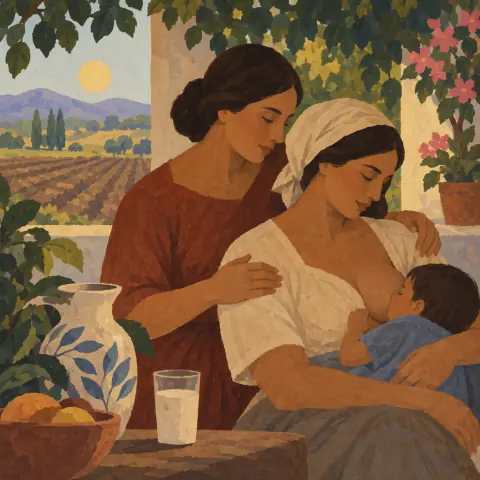
The milk imagery begins with hospitality: the woman will drink rich milk
from the speaker’s glass. By the ending, however, the direction of nourishment reverses. If the speaker’s breasts are not generous
, her son will nurse from the other woman, whose breasts are rich
. The laboring woman is therefore welcomed partly because she possesses an abundance the speaker may lack.
This shift introduces vulnerability into the speaker’s otherwise confident fantasy. Beneath her promise of protection lies fear: she may not be able to feed her own child. Motherhood is presented not as a self-sufficient bond but as a dependence that can pass between women. One body compensates for another, and the child belongs within a small communal system of nurture rather than to an isolated mother alone.
The Uneasy Generosity of Love
The tone is sensuous and hopeful, filled with milk, shade, arbors, pregnancy, and bodily richness. Yet the final arrangement remains morally unsettled. Is the stranger being honored as a sister whose strength will sustain a shared household, or absorbed into that household because her body is useful? The poem does not resolve the question. Its deepest claim is that love can create kinship through mutual need, but its language also reveals how easily care can become appropriation. The stranger is cherished for her resemblance to the speaker, while her separate self remains just beyond the poem’s reach.
Feel free to be first to leave comment.