
Sanctuary
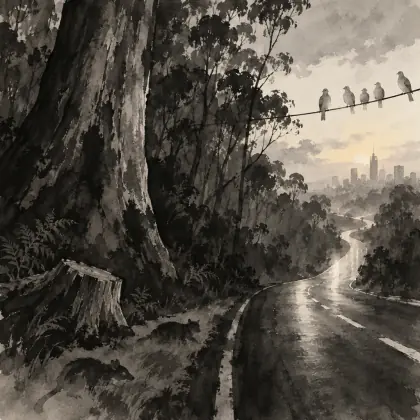
The road beneath the giant original trees sweeps on and cannot wait. Varnished by dew, its darkness mimics mirrors and is bright behind the panic eyes the driver sees caught in headlights. Behind his wheels the night takes over: only the road ahead is true. It knows where it is going: we go too. Sanctuary, the sign said. Sanctuary — trees, not houses; flat skins pinned to the road of possum and native cat; and here the old tree stood for how many thousand years? — that old gnome-tree some axe-new boy cut down. Sanctuary, it said: but only the road has meaning here. It leads into the world’s cities like a long fuse laid. Fuse, nerve, strand of a net, tense bearer of messages, snap-tight violin-string, dangerous knife-edge laid across the dark, what has that sign to do with you? The immense tower of antique forest and cliff, the rock where years accumulate like leaves, the tree where transient bird and mindless insect sing? The word the board holds up is Sanctuary and the road knows that notice-boards make sense but has no time to pray. Only, up to there, morning sets doves upon the power-line. Swung on that fatal voltage like a sign and meaning love, perhaps they are a prayer.
Sanctuary - meaning Summary
Road as False Sanctuary
Judith Wright's Sanctuary
contrasts an old forest and a roadside sign claiming protection with the forward momentum of a road and its drivers. The poem registers the collision between ancient natural life and human infrastructure: the road proceeds regardless, signs and sanctuaries become symbolic but powerless, and wildlife is exposed to danger. In the final image doves on a power-line suggest a fragile, ambiguous form of prayer or witness amid inevitable movement.
Feel free to be first to leave comment.