
Whatever You Say Say Nothing
I I'm writing this just after an encounter With an English journalist in search of 'views On the Irish thing'. I'm back in winter Quarters where bad news is no longer news, Where media men and stringers sniff and point, Where zoom lenses, recorders and coiled leads Litter the hotels. The times are out of joint But I incline as much to rosary beads As to the jottings and analyses of politicians and newspapermen Who've scribbled down the long campaign from gas And protest to gelignite and sten, Who proved upon their pulses 'escalate', 'Backlash' and 'crackdown', 'the provisional wing', 'Polarization' and 'long-standing hate'. Yet I live here, I live here too, I sing, Expertly civil tongued with civil neighbors On the high wires of first wireless reports, Sucking the fake taste, the stony flavours Of those sanctioned, old, elaborate retorts: 'Oh, it's disgraceful, surely, I agree.' 'Where's it going to end? It's getting worse.' 'They're murderers.' 'Internment, understandably...' The voice of sanity is getting hoarse. II Men die at hand. In blasted street and home The gelig nite's a common sound effect. As the man said when Celtic won, 'The Pope of Rome's A happy man this night.' His flock suspect In their deepest heart of hearts the heretic Has come at last to heel and to the stake. We tremble near the flames but want no truck With the actual firing. We're on the make As ever. Long sucking the hind tit Cold as a witch's and as hard to swallow Still leaves us fork-tongued on the border bit: The liberal papist note sounds hollow When amplified and mixed in with the bangs That shake all hearts and windows day and night. (It's tempting here to rhyme on 'labour pangs' And diagnose a rebirth in our plight But that would be to ignore other symptoms. Last night you didn't need a stethoscope To hear the eructation of Orange drums Allergic equally to Pearse and Pope.) On all sides 'little platoons' are mustering - The phrase is cruise O'Brian's via that great Backlash, Burke - while I sit here with a pestering Drouth for words at once both gaff and bait To lure the tribal shoals to epigram And order. I believe any of us Could draw the line through bigotry and sham Given the right line, aere perennius. III 'Religion's never mentioned here,' of course. 'You know them by their eyes,' and hold your tongue. 'One side's as bad as the other,' never worse. Christ, it's near time that some small leak was sprung In the great dykes the Dutchman made To dam the dangerous tide that followed Seamus. Yet for all this art and sedentary trade I am incapable. The famous Northern reticence, the tight gag of place And times: yes, yes. Of the 'wee six' I sing Where to be saved you only must save face And whatever you say, you say nothing. Smoke-signals are loud-mouthed compared with us: Manoeuvrings to find out name and school, Subtle discrimination by addresses With hardly an exception to the rule That Norman, Ken and Sidney signalled Prod And Seamus (Call me Sean) was sure-fired Pape. O land of password, handgrip, wink and nod, Of open minds as open as a trap, Where tongues lie coiled, as under flames lie wicks, Where half of us, as in a wooden horse Were cabin'd and confined like wily Greeks, Besieged within the siege, whispering morse. IV This morning from the dewy motorway I saw the new camp for the internees: A bomb had left a crater of fresh clay In the roadside, and over in the trees Machine-gun posts defined a real stockade. There was that white mist you get on a low ground And it was deja-vu, some film made of Stalag 17, a bad dream with no sound. Is there a life before death? That's chalked up In Ballymurphy. Competence with pain, Coherent mistress, a bite and sup, We hug our little destiny again.
Whatever You Say Say Nothing - context Summary
Written Amid the Troubles
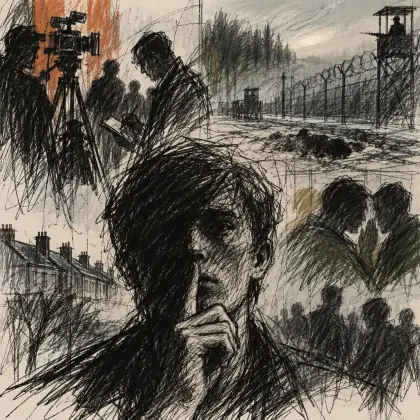
Written during the Northern Ireland Troubles and included in North (1975), the poem responds to Heaney’s uneasy encounter with an English journalist. He shows how outsiders and local people alike reduce the conflict to slogans, coded speech, and cautious public statements. The poem moves from media language and political jargon to the reality of internment and fear, capturing a society where speaking openly can feel dangerous.
Feel free to be first to leave comment.