
The Kingfisher
The kingfisher rises out of the black wave like a blue flower, in his beak he carries a silver leaf. I think this is the prettiest world--so long as you don't mind a little dying, how could there be a day in your whole life that doesn't have its splash of happiness? There are more fish than there are leaves on a thousand trees, and anyway the kingfisher wasn't born to think about it, or anything else. When the wave snaps shut over his blue head, the water remains water--hunger is the only story he has ever heard in his life that he could believe. I don't say he's right. Neither do I say he's wrong. Religiously he swallows the silver leaf with its broken red river, and with a rough and easy cry I couldn't rouse out of my thoughtful body if my life depended on it, he swings back over the bright sea to do the same thing, to do it (as I long to do something, anything) perfectly.
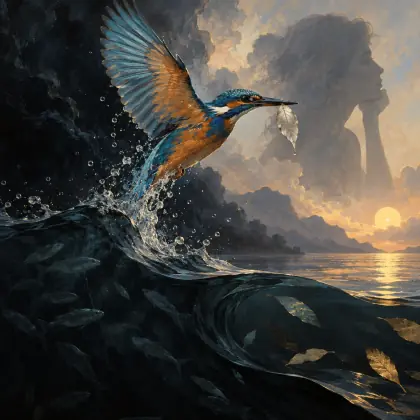
The Kingfisher - meaning Summary
Instinct Against Self-consciousness
The poem contrasts the kingfisher's instinctive life with the speaker's self-conscious longing. Its beauty depends on predation and death: the bird sees hunger as a simple fact, while the speaker reflects on its cost. Watching the kingfisher repeatedly hunt, the speaker admires its complete absorption in action and wishes to escape thought long enough to do one necessary thing perfectly.
Feel free to be first to leave comment.