
Where Does the Dance Begin, Where Does It End?
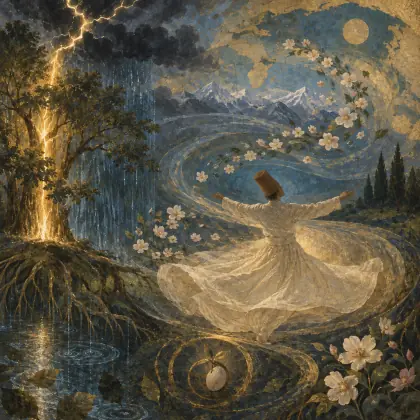
Don't call this world adorable, or useful, that's not it. It's frisky, and a theater for more than fair winds. The eyelash of lightning is neither good nor evil. The struck tree burns like a pillar of gold. But the blue rain sinks, straight to the white feet of the trees whose mouths open. Doesn't the wind, turning in circles, invent the dance? Haven't the flowers moved, slowly, across Asia, then Europe, until at last, now, they shine in your own yard? Don't call this world an explanation, or even an education. When the Sufi poet whirled, was he looking outward, to the mountains so solidly there in a white-capped ring, or was he looking to the center of everything: the seed, the egg, the idea that was also there, beautiful as a thumb curved and touching the finger, tenderly, little love-ring, as he whirled, oh jug of breath, in the garden of dust?
Where Does the Dance Begin, Where Does It End? - meaning Summary
Mystery in Ceaseless Motion
The poem resists treating nature as either comforting, useful, or fully explainable. It presents the world as restless and mixed: lightning can destroy, rain can nourish, wind can create movement, and flowers migrate across continents. Turning to a Sufi dancer, the speaker asks whether attention belongs to the visible world or to an inner source of life. The poem suggests that both mystery and tenderness exist within constant motion.
Feel free to be first to leave comment.