
Analysis of Alexander Selkirk
The castaway who returned without returning
Borges imagines Alexander Selkirk not as a man triumphantly rescued from solitude, but as someone divided by rescue. Historically, Selkirk was the sailor whose years alone on an island helped inspire the story of Robinson Crusoe. Here, however, survival is not the conclusion. The restored man remains haunted by the self who watched the sea for five years. The poem’s central paradox is that Selkirk is physically among my people
yet cannot fully communicate with the person he became in isolation.
The sea inside the dream
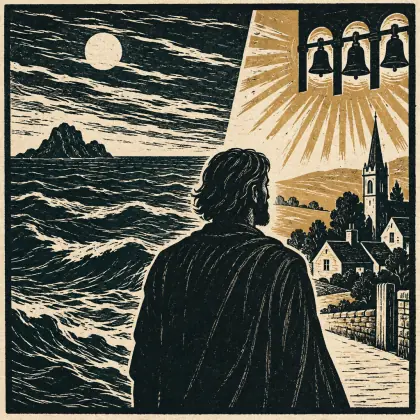
The opening begins with apparent safety but immediately unsettles it. Selkirk dreams that the sea surrounds me still
, as if the island has followed him home. The repeated phrase that sea, that sea
gives the water an obsessive specificity: it is not simply a landscape but the force that defined his consciousness. The ringing church bells awaken him and sanctifies the mornings
of familiar English fields. Their ordered sound opposes the sea’s boundlessness, while the appeal to God suggests that returning to ordinary life feels almost like being restored to spiritual as well as social existence.
Yet the word still
weakens that restoration. It means both that the sea continues to surround him in memory and that some part of him remains motionless there, fixed in the old act of watching. The tone is therefore grateful but uneasy. England is recognizable and protected, but the dream reveals that familiarity has not erased exile.
Infinity becomes a tavern story
Selkirk says he spent five years gazing at solitude and infinity
. The phrasing turns abstract ideas into visible things, as though isolation stripped the world down to its most overwhelming dimensions. After his return, those experiences have become that story I repeat
in taverns. What was once immediate terror and endless waiting is now an anecdote told among drinkers.
This produces one of the poem’s sharpest tensions. Repetition should allow Selkirk to master his past, but he calls it an obsession
. Every retelling makes him sociable while also returning him mentally to the island. His listeners may hear an extraordinary adventure; he remembers a state of being that language cannot adequately reproduce. The tavern story gives his suffering a public shape, but that shape may falsify it by making the experience entertaining, finite, and repeatable.
Mirrors, doors, numbers, names
The world of men is represented through mirrors, doors, numbers and names
. These are ordinary objects and systems, yet their enumeration makes civilization sound strangely artificial. Mirrors provide a recognizable identity; doors divide one space from another; numbers measure; names distinguish. On the island, by contrast, Selkirk confronted a sea compared to a fathomless steppe
, an expanse without stable boundaries. He has returned from immeasurable existence to a world that classifies and contains.
There is comfort in that containment, but also loss. Selkirk says he has ceased to be
the man who eternally scanned the sea. Yet the poem itself disproves him: his dreams, stories, and final question show that the watcher persists. Civilization has restored his social identity while turning his island identity into a separated other
.
A message that cannot cross time
The closing question is the poem’s decisive turn. Selkirk wants to tell that other
that he is home and safe and sound
. Logically, the wish is impossible: the abandoned watcher is his former self, existing only in memory. Emotionally, however, that self remains stranded because he never knew rescue would come. The returned Selkirk possesses knowledge that could have consoled him then, but cannot send it backward through time.
The ending therefore makes rescue incomplete. One Selkirk lives among his people; another continues to scan the horizon without hope. Borges’s haunting claim is that extreme suffering can create a past self who does not disappear when circumstances change. Safety belongs to the present man, but the castaway within him has never received the news.
Feel free to be first to leave comment.