
The Golem
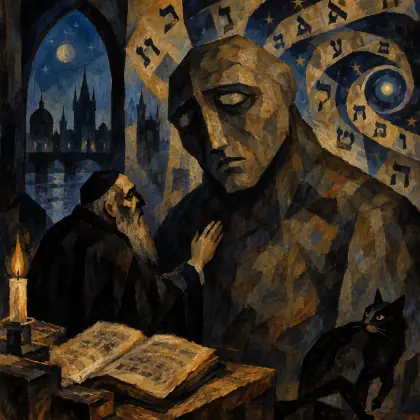
If (as affirms the Greek in the Cratilo) the name is archetype of the thing, in the letters of "rose" is the rose, and all the Nile flows through the word. Made of consonants and vowels, there is a terrible Name, that in its essence encodes God's all, power, guarded in letters, in hidden syllables. Adam and the stars knew it in the Garden. It was corroded by sin (the Cabalists say), time erased it, and generations have forgotten. The artifice and candor of man go on without end. We know that there was a time in which the people of God searched for the Name through the ghetto's midnight hours. But not in that manner of those others whose vague shades insinuate into vague history, his memory is still green and lives, Judá the Lion the rabbi of Prague. In his thirst to know the knowledge of God Judá permutated the alphabet through complex variations and in the end pronounced the name that is the Key the Door, the Echo, the Guest, and the Palace, over a mannequin shaped with awkward hands, teaching it the arcane knowledge of symbols, of Time and Space. The simulacrum raised its sleepy eyelids, saw forms and colors that it did not understand, and confused by our babble made fearful movements. Gradually it was seen to be (as we are) imprisoned in a reverberating net of Before, Later, Yesterday, While, Now, Right, Left, I, You, Those, Others. The Cabalists who celebrated this mysterium, this vast creature, named it Golem. (Written about by Scholem, in a learned passage of his volume.) The rabbi explained the universe to him, "This is my foot, this yours, and this the rope," but all that happened, after years, was that the creature swept the synagogue badly. Perhaps there was an error in the word or in the articulation of the Sacred Name; in spite of the highest esoteric arts this apprentice of man did not learn to speak. Its eyes uncanny, less like man than dog and much less than dog but thing following the rabbi through the doubtful shadows of the stones of its confinement. There was something abnormal and coarse in the Golem, at its step the rabbi's cat fled in fear. (That cat not from Scholem but of the blind seer) It would ape the rabbi's devotions, raising its hands to the sky, or bend over, stupidly smiling, into hollow Eastern salaams. The rabbi watched it tenderly but with some horror. How (he said) could I engender this laborious son? Better to have done nothing, this is insanity. Why did I give to the infinite series a symbol more? To the coiled skein on which the eternal thing is wound, I gave another cause, another effect, another grief. In this hour of anguish and vague light, on the Golem our eyes have stopped. Who will say the things to us that God felt, at the sight of his rabbi in Prague?
Translated by James HonzikThe Golem - meaning Summary
Creation Mirrors Its Creator
Borges retells the Jewish legend of a Prague rabbi who uses sacred language to animate a Golem. The creature can imitate actions but cannot understand or speak, exposing the limits of human attempts to reach divine creative power. As the rabbi pities and fears his clumsy creation, the poem turns the story outward: humanity itself may be an unfinished creation, seen by God with the same uneasy tenderness.
Read Complete Analyses
Feel free to be first to leave comment.