
A Poet of the Thirteenth Century
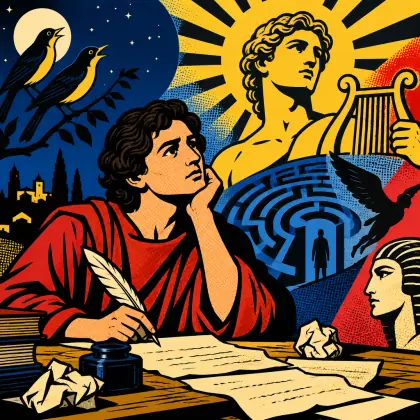
He looks again through drafts he struggled with of that first sonnet, still to be named, sees now the haphazard way he intermingled tercets and quatrains, his flouting of good taste. With a slow pen, he smoothes its roughness, then pauses. Did he perhaps just hear, portent of some future and its holy terror, the distant singing of nightingales? Will he have felt that he was not alone, that the incredible Apollo, the arcane, had just revealed an archetype, unclouded, voracious to embrace whatever night conceals or day reveals: Daedalus, labyrinth, enigma, Oedipus?
Translated by Allen ProwleA Poet of the Thirteenth Century - meaning Summary
Craft Meets Timeless Archetypes
The poem imagines an early medieval poet revising an experimental sonnet and sensing that poetry connects him to something larger than personal craft. His uncertainty about form becomes a moment of inspiration: Apollo seems to reveal enduring patterns of myth, including the labyrinth and Oedipus. Borges presents poetic creation as both painstaking revision and an encounter with archetypes that reach across time.
Read Complete Analyses
Feel free to be first to leave comment.