
Analysis of Alhambra
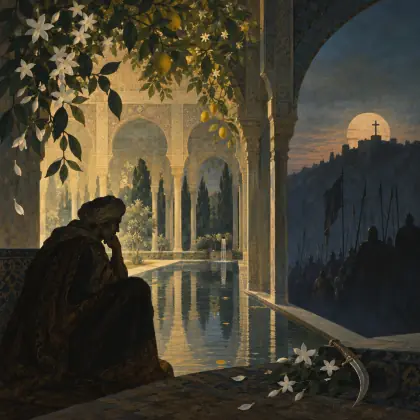
A Welcome Already Shadowed by Loss
The Alhambra appears here not simply as a beautiful place, but as a beauty made more intense by the certainty that it will be lost. The opening repeatedly says Welcome
, receiving the palace through sound, touch, fragrance, music, faith, and love. Yet the poem abruptly turns from hospitality to military defeat: Vain the scimitar
. By the end, every welcome has become a farewell. Borges makes the Alhambra most fully present at the moment when its disappearance from Muslim rule is unavoidable.
Water, Marble, and Jasmine
The palace is approached as a sequence of intimate sensations rather than as a grand monument. Water has a voice
; marble becomes a smooth column
beneath a curved hand; streams form slender labyrinths
among lemon trees; jasmine enters through scent. These details make the Alhambra feel delicate, cool, and responsive to the human body. Even the word labyrinths
, closely associated with Borges’s writing, is softened here: this is not a threatening maze but an intricate circulation of water, a pattern that can be heard and touched as much as seen.
The phrase black sand overwhelmed
introduces darkness into this sensuous welcome. It may suggest time, death, blindness, or some more general condition of deprivation. Whatever its exact meaning, the person being welcomed has come from an experience of engulfment. The palace therefore offers restoration: flowing water against dead sand, polished marble against obscurity, jasmine against barrenness. Yet the restoration cannot last. Water itself, for all its freshness, is also a traditional figure for time passing.
One God, Two Civilizations
The references to the melodious zéjel
, the scimitar, and prayer to a God who is One
place the palace within Muslim Andalusia. The zéjel is an Andalusian song form, so the Alhambra’s music is inseparable from the culture that created it. Against this world come the long lances
and the infidels’ cross
. The word infidels
adopts the defeated Muslim perspective: Christian victory is not presented as providential triumph, but as the eclipse of one sacred order by another. When the cross eclipses the moon
, the image is both political and cosmic. Conquest changes the signs under which the world is understood.
The Strange Consolation of Foreknowledge
The poem’s most unsettling claim arrives with Good to know, foreknow
. The grieving king is likely the last Nasrid ruler of Granada, whose defeat brought the Alhambra under Christian control in 1492. Why should it be good to know that the scimitar is useless, that the key
will be refused, and that the afternoon will be the last? Foreknowledge cannot prevent defeat. Its value lies instead in making the final experience lucid. The king can recognize that his courtesies are already farewells and can look at the palace with the complete attention that only impending loss creates.
The Courtesy of Defeat
A painful contradiction governs the ending: the king is praised for refinement at the very moment refinement proves powerless. Vain to be the best
means that courage, nobility, or excellence cannot defeat a larger army. Still, the poem does not treat courtesy as meaningless. Military resistance is vain, but dignified attention remains possible. The king cannot keep the Alhambra, yet he can understand his final afternoon within it.
The repeated welcomes thus acquire a double voice. They welcome the visitor into the palace, but they also preserve what the defeated king must leave: water, marble, lemon trees, song, prayer, and jasmine. Political possession passes to the conquerors; memory answers by naming each beloved thing. In that sense, the poem becomes a final act of hospitality offered across centuries—an invitation into a vanished world whose beauty survives precisely because its farewell has been remembered.
Feel free to be first to leave comment.