
Analysis of Chess
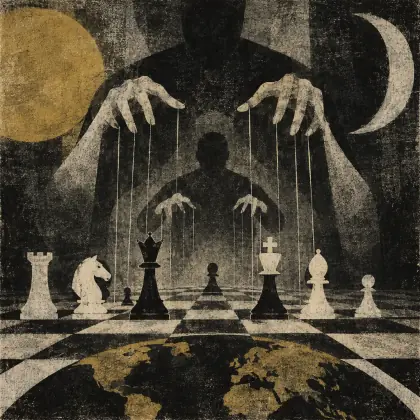
The Board Beneath the Board
Borges turns chess into a model of existence in which every apparent agent may be another agent’s piece. The poem begins with a familiar scene: two players remain at a board until dawn, directing a conflict between black and white. It then repeatedly widens the frame. The pieces are governed by players; the players are governed by time and circumstance; God governs the players; and the closing question imagines an unknown power governing God. Chess therefore becomes more than a metaphor for fate. It exposes the frightening difficulty of locating any final source of freedom, intention, or creation.
Hatred Inside a Serious Corner
The opening quietly contrasts the smallness of the setting with the grandeur of the imagined war. The players occupy a serious corner
, while the board confines them within its strict ambit
. Yet inside that limited square, two colors hate each other
. Hatred is attributed not to the players but to the opposing colors themselves, as though the abstract division between black and white already contains the seed of conflict.
The pieces likewise become characters from an archaic epic: the rook is homeric
, the queen is armed, the bishop moves obliquely, and the pawns are assailants. The language gives these carved objects an imaginary inner life. At the same time, their identities are inseparable from their permitted movements. The bishop is defined by its diagonal path, the rook by straightness, the king by vulnerability. Their personalities are rules mistaken for character.
A War Older Than Its Warriors
The first major turn comes when the human players disappear. After time has eaten them
, the ritual continues. This does not simply mean that future generations will keep playing chess. It suggests that the conflict is more durable than any individual participant. Players believe they temporarily activate the game, but Borges reverses that relation: the game outlives and, in a sense, uses them.
The poem traces this ritual to the East
and gives it an amphitheater encompassing the world. Its infinity is both historical and metaphysical. Chess has crossed cultures and centuries, but the pattern it embodies—the division into camps, the calculated sacrifice, the struggle for mastery—also repeats outside the board. The phrase as the other
links this stylized battle to real war. Chess may imitate war, yet war itself can look like another vast game whose participants inherit roles and rules they did not choose.
Pieces That Cannot Know
Part II moves imaginatively inside the board. The king is weak
, the bishop biased
, the queen embittered
, and the pawn wily
. These descriptions grant the pieces temperaments, making their struggle seem voluntary. But the repeated statement they do not know
strips away that illusion. An appointed hand
governs their fate, while an adamantine rigor
controls both their will and their journey.
The central contradiction is severe: the pieces possess something called will
, but that will is subjected to an unbreakable order. Borges does not merely say that their actions are constrained. He suggests that even what they experience as desire may belong to the game’s design. The embittered queen may believe she chooses aggression; the pawn may regard its advance as cunning. From outside the board, however, personality, decision, and destiny collapse into a single move made by someone else.
Black Nights and White Days
The poem’s most unsettling reversal occurs when the player is placed in the same condition as the piece. The apparent master is also prisoner
on another board, one composed of black nights
and white days
. The chessboard’s alternating squares become the alternating conditions of human time. Day and night seem open and immense compared with sixty-four squares, but Borges treats them as another bounded field through which people move according to laws they only partly understand.
This reversal changes the tone from ceremonial wonder to metaphysical unease. Earlier, the players appeared to rule their slow pieces
. Now their authority looks local and temporary. They can direct the bishop or sacrifice the pawn, but they cannot prevent dawn, aging, or the time that eventually eats them. The person who exercises power in one frame may be powerless in the next.
The Hand Behind God
The final lines state a hierarchy—God moves the player, who moves the piece—only to make that hierarchy unstable. A conventional religious answer would end with God as the first cause. Borges instead asks what God behind God
began the whole weaving. The question produces an infinite regress: if complex order implies a mover, why should the divine mover escape that same logic?
The word weaving
broadens the chess metaphor. Existence is not made from solid certainties but from dust and time and dream
, together with the physical agony of death. Dust implies mortality, time implies succession, and dream raises the possibility that perceived reality is itself only a constructed appearance. These materials are woven together, but the identity of the weaver remains inaccessible.
Freedom as a View from Too Close
The poem never proves that human freedom is unreal. Instead, it shows how freedom changes according to perspective. From within the game, each move can feel urgent, intelligent, and chosen. From above, the same move belongs to a pattern already authorized by another hand. Yet every supposed outside may itself be an inside: the player stands above the pieces but remains enclosed by days and nights, while even God becomes part of a question larger than God.
The final effect is not simple despair. Borges preserves the dignity and intensity of the struggle even while denying it ultimate independence. The pieces still wage battle; the players still think through the night; human beings still inhabit time, dream, and mortality. What disappears is the confidence that any participant can see the whole board. The game is infinite because there may always be another board beyond the one we mistake for reality.
Feel free to be first to leave comment.