
Analysis of Elegy For A Park
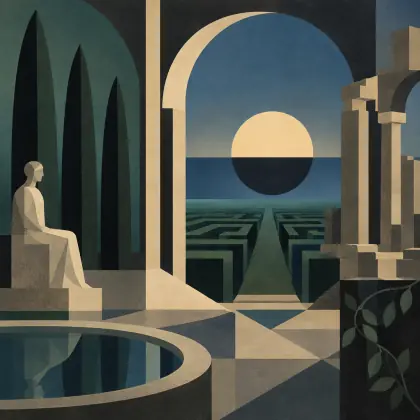
From a vanished park to a vanished present
Borges begins by mourning a particular place, but the park soon becomes evidence for a larger and more unsettling claim: nothing merely enters the past, because everything is already made of time and therefore already disappearing. The elegy moves from familiar objects to ruined civilizations, dissolving the distinction between a lost landscape, human beings, and history itself. Its tone changes accordingly. What starts as wistful recollection becomes a calm, almost impersonal meditation on existence.
The inventory of disappearance
The opening gathers the park through a sequence of remembered details: eucalyptus trees, summer awnings, honeysuckle, an arbour, statues, birdsong, a fountain. Their specificity gives the loss emotional force. This is not an abstract paradise but a place once shaped by shade, sound, vegetation, and human leisure. Yet the first object named is the labyrinth, a characteristically Borgesian image of complexity and uncertain direction. To say The labyrinth is lost
means not only that a garden feature has vanished, but that even the pattern by which the place might be recovered has disappeared.
Several details quietly contradict one another. The clock is stopped
, yet the park remains subject to time. The fountain is idle
, while the poem’s final image imagines time as a flowing river. The statues seem enduring but are dismissed as frivolous
; the birds’ trills are momentary, yet memory preserves them. Borges makes permanence and transience exchange qualities. Solid objects vanish, while fleeting sounds survive in language.
The mirror that keeps nothing
The park’s mirror is described as maintaining an unending vigil, repeating every human face
and everything fleeting. A mirror seems faithful because it omits nothing placed before it, but it also retains nothing. Its constant repetition is therefore a form of constant erasure: each face replaces the one before it. The mirror becomes a model of time itself, endlessly receiving appearances without preserving their living presence. The poem performs a different kind of reflection. It cannot restore the park, but it can hold selected traces of it after the physical place has gone.
The question that breaks the elegy open
The decisive turn comes with the abrupt question Of the past?
Until then, the speaker has treated the park as a completed loss. The question unsettles that ordinary division between what is gone and what remains. If time has no beginning, no ending
, then the present cannot stand securely outside the past. The alternation of white days and black nights
suggests an endless succession, but Borges calls that succession a sum
, as though a human life were already a completed total even while it is being lived.
This produces the poem’s central paradox: we are already the past
that we will become. The statement is not simply a reminder that everyone dies. It denies that identity can be separated from disappearance. We do not first exist and then get carried away by time; our existence is the carrying away.
The river includes its ruins
The final stanza expands the park into world history. Uxmal, Carthage, and the Roman walls represent civilizations whose grandeur has become ruin, but Borges does not present them as distant warnings aimed at the present. Instead, he joins them grammatically to we
: humanity is the ancient city, the broken wall, and the forgotten garden. The declaration We are time
goes further than saying that we live in time. The river is indivisible
, so individual people, lost places, and fallen empires are not separate episodes but forms taken by one continuous process.
The ending nevertheless gives poetry a modest commemorative power. The park is lost, yet it exists here as the lost park
named by these lines. The poem does not defeat time; indeed, it admits that the poem, too, belongs to the river. Its consolation is subtler: remembrance cannot preserve a place unchanged, but it can reveal that loss is not an accident imposed on existence. Loss is the substance that the park, its visitors, ancient cities, and the elegy itself share.
Feel free to be first to leave comment.