
Analysis of Emerson
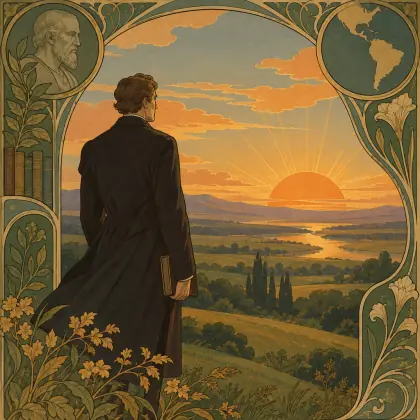
The Walk from Books into Evening
Borges presents Ralph Waldo Emerson as a man who possesses intellectual greatness yet suspects that knowledge has kept him at a distance from life. The poem begins with a small act of transition: the tall American gentleman
closes Montaigne and goes outdoors. He hopes to find in the evening an enjoyment equal to reading, but that comparison already reveals his difficulty. Even direct experience must compete with a book. The plain evening is beautiful precisely because it simply exalts the plain
, while Emerson’s mind is crowded with learning, achievement, and self-consciousness.
Sunset Seen Through Memory
The walk moves toward the deep and setting sun
, an image that suggests both natural splendor and the approach of death. Yet Borges does not allow the scene to remain purely Emerson’s. As Emerson walks through the fields, Borges walks through memory: as now through memory
does the poet writing about him. This quiet interruption collapses the distance between the two writers. Emerson becomes not only a historical figure but also a possible image of the poet himself—a literary man reconstructing another literary man and recognizing the danger of inhabiting words more fully than the world.
The Inventory of Greatness
Emerson’s thoughts initially sound assured. He has read the essential books
, written works worthy of survival, acquired as much knowledge as mortals may receive, and become famous across a continent. The scale rises steadily from private reading to divine favor to public reputation. But the grandeur is uneasy. His claim that a god has gifted me
knowledge suggests gratitude, yet it also places a limit on human attainment: even the highest wisdom remains only what mortals are permitted to know. His books may defeat dark oblivion
, but literary survival is not the same as having lived fully.
The Sentence That Cancels the Triumph
The poem turns violently in its final two statements: I have not lived
and I would I were another man
. Everything before them becomes evidence for the prosecution. Reading, writing, wisdom, and fame no longer prove a successful life; they appear as substitutes for one. The brevity of the confession is crucial. After the elevated language of gods, knowledge, and continental renown, Emerson judges himself in the simplest possible terms. The plainness he admired in the evening is exactly what his life seems to lack.
A Self That Cannot Be Read Away
The deepest contradiction is that Emerson wants to be another man while standing at the summit of the identity he has made. His name is widely known, but that famous name has become a confinement. Nor can another book solve the problem: he has already read what is essential. The closing wish therefore expresses more than regret over missed pleasures. It is the impossible desire to exchange consciousness itself—to become someone who does not measure an evening against Montaigne, or life against the books that preserve his name.
The Cruelty of the Plain Evening
The sunset offers no accusation; it merely gilds the horizon. That indifference makes Emerson’s realization harsher. Nature gives him the ordinary life he longs for—a walk, fields, fading light—but he can encounter it only through reflection. Borges’s portrait finally suggests that intellectual mastery may sharpen rather than cure regret: Emerson knows enough to recognize the life he has missed, but not enough to become the other man he desires.
Feel free to be first to leave comment.