
Analysis of The Golem
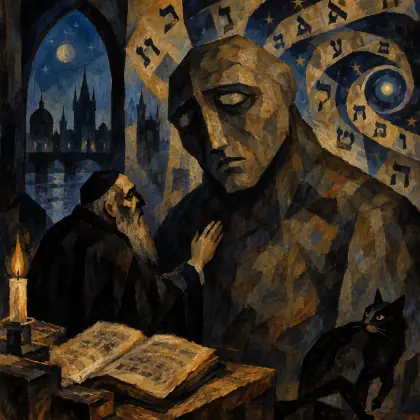
The Creator Reflected in the Creature
The poem turns the legend of the Golem into a disturbing argument about creation: every maker passes his own limitations into what he makes. At first, the rabbi appears to imitate divine power by discovering the sacred Name and animating matter. By the end, however, the hierarchy has folded in on itself. The Golem is to Rabbi Judá as Judá—and perhaps humanity—is to God. The closing question, asking what God felt at the sight of his rabbi
, transforms the entire story. The rabbi’s disappointment in his clumsy creation may be an image of God’s disappointment, pity, or horror before us.
The Rose Hidden in Its Name
The opening imagines a perfect correspondence between language and reality. If a name is the archetype of the thing
, then the letters of rose
somehow contain the actual rose, just as the Nile is mystically present in its word. Language here is not merely a system for describing the world; it is the world compressed into signs. That possibility leads to the terrible Name
of God, whose syllables supposedly hold divine power.
Yet the poem immediately places this ideal language at a distance. Adam and the stars once knew the Name, but sin corroded it, time erased it, and generations forgot it. Human beings therefore inherit a damaged relation to words. Rabbi Judá’s permutations of the alphabet are both sublime and desperate: he searches among fragmented letters for a unity that history has lost. The tension is sharp. Language promises access to creation, but the language available to human beings is already incomplete.
The Key That Becomes a Cage
When Judá finally pronounces the Name, it is called the Key
, the Door
, the Echo
, the Guest
, and the Palace
. These terms suggest that the Name is not one object among others. It is simultaneously entrance, dwelling, presence, and repetition—the total architecture of reality. But the being awakened by this supreme word does not enter the world with divine understanding. The Golem opens sleepy eyelids
and sees colors and forms that it cannot comprehend.
The decisive image is the reverberating net
composed of words such as Before, Later, I, You, Right, and Left. The net is consciousness itself: time, identity, relation, and position are all organized by language. Yet what organizes experience also imprisons it. The Golem cannot reach reality directly; it receives a confusing grid of distinctions. The parenthetical phrase as we are
removes any safe distance between creature and reader. His bewilderment is not an exotic defect. It is an exaggerated version of the human condition.
A Sacred Miracle Sweeping Badly
The poem’s tone shifts from metaphysical awe toward dry comedy. After the rabbi explains the universe through such examples as my foot
, yours
, and the rope
, the result of years of instruction is that the creature swept the synagogue badly
. The bathos is deliberate. A being produced through the hidden Name of God cannot perform even a humble task competently. The gap between the grandeur of the method and the poverty of the result makes the miracle absurd.
That absurdity does not cancel the poem’s sadness. The Golem cannot speak; it imitates prayers, raises its hands, bows, and smiles without understanding. His devotions are gestures emptied of inward meaning. Even his physical presence is hard to classify: he is less like a person than a dog, yet much less than dog
. The awkward comparison suggests that he lacks not only reason but also the instinctive wholeness of an animal. He is a thing forced toward personhood without being allowed to arrive there.
The Laborious Son
Rabbi Judá responds with a mixture of tenderness and horror. Calling the Golem his laborious son
reveals genuine attachment, but also the burden of having made a life that cannot flourish. His regret—Better to have done nothing
—is not simply embarrassment over failure. He realizes that creation adds suffering to existence. By making the Golem, he has given the infinite chain of causes and effects another grief
.
This is the poem’s moral center. Creation is usually treated as an affirmation of power, knowledge, or love. Here it is also an act for which the creator may be guilty. Judá did not intend cruelty, but his thirst for divine knowledge produced a dependent being confined among symbols it cannot master. The Golem’s misery comes precisely from the rabbi’s aspiration to transcend human limits.
What God May Have Seen
The last stanza makes the rabbi occupy the Golem’s former position. Our eyes rest on the creature, but the poem asks us to imagine God’s eyes resting on Judá. The rabbi who sees abnormality, imitation, and failed understanding in his creation may himself appear equally clumsy from a divine perspective. His cabalistic learning, like the Golem’s hollow bows, might be an imperfect copy of an order beyond his comprehension.
The ending does not state that humanity is God’s mistake. Its question is more unsettling because it remains unanswered. God may feel horror, disappointment, tenderness, or the same anguished combination that Judá feels. The poem therefore closes not by dismissing the Golem as a monster, but by making him our mirror. We too awaken among forms we only partly understand, caught in names, causes, time, and pronouns. Our deepest knowledge may still be a badly performed imitation—and yet the tenderness of the rabbi suggests that imperfection does not make a creature unworthy of love.
Feel free to be first to leave comment.