
Analysis of Inferno V 129
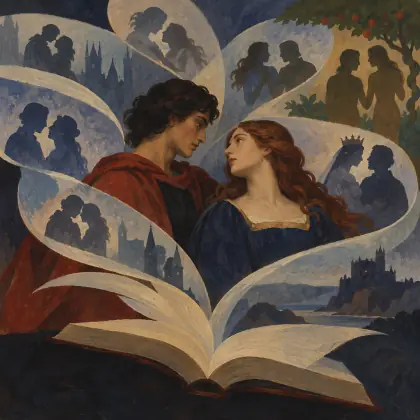
The instant when reading becomes fate
Borges returns to the famous episode in Dante’s Inferno in which Paolo and Francesca, reading the story of Lancelot and Guinevere, are drawn into an adulterous kiss. His central claim is that love begins here as an act of recognition: the lovers discover themselves inside an older story, then become a story in which later readers will recognize themselves. Books do not merely reflect their desire. They reveal that desire has already placed them inside a pattern larger than their individual lives.
The opening captures the decisive shock: Paolo and Francesca drop the book when they realize they are the ones
it describes. Before this moment, they are simply two friends
enjoying a romance. Afterward, their ordinary identities give way to legendary ones. They are no longer detached readers judging fictional lovers; they have become Paolo and Francesca precisely by seeing themselves as Lancelot and Guinevere. The book gives their desire a name, and once named, it becomes unavoidable.
A kiss suspended outside the poem
Borges stops just before physical contact: Their hands do not touch.
The restraint matters. Dante’s Francesca recounts how the reading led to a kiss, but Borges concentrates on the fraction of time in which recognition has occurred and action has not. The sole treasure
they discover is not yet bodily possession but the knowledge that each loves the other. This makes the scene tender, hushed, and almost innocent, despite everything the reader knows will follow.
The tone is therefore strikingly different from the punishment and anguish surrounding Paolo and Francesca in Dante. Borges removes the infernal storm and fixes attention on their incredulous wonder.
For the lovers, the instant is not sinful or tragic. It feels like revelation. Yet the tenderness carries an unavoidable tension: the reader knows that this discovery will lead to betrayal, death, and damnation. Their happiness is pure only because Borges holds time still before its consequences arrive.
A world reduced to two people
The poem makes its boldest claim when it says they betray no Malatesta
because betrayal requires a third person, while Paolo and Francesca are the only two on earth.
Historically and morally, this is plainly untrue: Francesca’s husband, a Malatesta, exists, and the lovers’ relationship betrays him. But Borges is describing the inward logic of passion rather than offering a legal defense. In the lovers’ consciousness, the world has contracted until no one else remains real enough to be wronged.
This is both romantic and disturbing. Their complete absorption makes love seem absolute, but that absoluteness depends on erasing another human being. Borges neither condemns nor fully excuses them. Instead, he identifies a contradiction within passionate love: it can feel like the discovery of ultimate reality while also producing blindness to the reality of everyone outside the pair.
From one forbidden couple to every couple
Once Paolo and Francesca recognize themselves in the Arthurian lovers, their identities begin to expand. They are also the queen and her lover
, meaning Guinevere and Lancelot, and then all the lovers
reaching back to Adam and Eve. The movement makes their private attraction archetypal. Every pair imagines itself unique, yet every pair reenacts an ancient story of desire, choice, and exclusion.
The reference to Eden intensifies the ambiguity. Adam and Eve represent both primal companionship and the act that leads to exile. Likewise, Paolo and Francesca’s recognition is at once a paradise and a fall. They have found one another
, but in doing so they enter a pattern that already contains loss. Love grants them a world of two and expels them from the ordinary moral world inhabited by others.
Books inside books, dreams inside dreams
The poem’s deepest movement is recursive. A book about Lancelot and Guinevere causes Paolo and Francesca to understand their own love. Dante’s Comedy then turns Paolo and Francesca into figures read by later generations. Borges’s poem adds still another book to this chain. The parenthetical remark that they will appear in another, greater
book points toward Dante, but its quiet question—what can that matter
—keeps the perspective with the lovers. Future literary immortality means nothing beside their immediate discovery.
Borges then describes the Arthurian romance as a dream
dreamed in Brittany. This does not make it unreal in any simple sense. On the contrary, the fictional dream changes the lovers’ lives, while their own story will shape the dreams of readers. Imagination passes from book to person and back into another book. What is invented can produce genuine recognition, desire, and suffering.
The readers are not outside the dream
The final turn extends the uncertainty to us. Another book will make men, dreams also
, dream of Paolo and Francesca. The phrase suggests that human beings may be no more solid than the fictional characters they read about. Paolo and Francesca are forms inside an Arthurian dream, then characters inside Dante’s vision, then presences inside Borges’s poem; readers who imagine themselves safely outside these layers may inhabit yet another one.
The ending therefore transforms a scene of romantic identification into a meditation on literary existence. Paolo and Francesca become real to themselves by finding their likeness in a book, and they become real to posterity because other people continue to dream them. Borges leaves no firm boundary between lover, reader, character, and dreamer. The lovers drop their book because fiction has suddenly become their life; we finish Borges’s poem with the unsettling possibility that the same thing has happened to us.
Feel free to be first to leave comment.