
Analysis of The Labyrinth 2
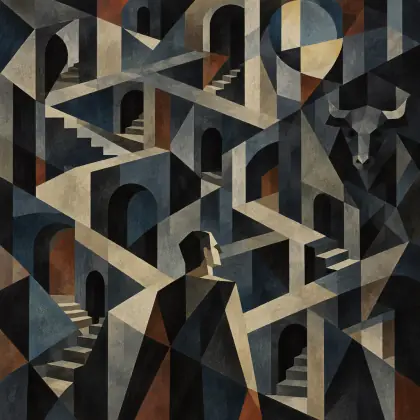
A Prison Without an Outside
Borges turns the mythical labyrinth into something more absolute than a building: a condition from which escape is logically impossible. The opening declaration, There’ll never be a door
, does not mean merely that the speaker cannot find an exit. It means no exit exists. The person addressed is already inside a keep
that encompasses the world
. If the prison contains everything, there can be no external place to which one might flee. The poem’s central claim is therefore severe: the deepest labyrinth is not a complicated space within the world, but the world as experienced by a consciousness trapped in it.
No Center, No Point of View
The labyrinth lacks the features that would make it understandable as an object. It has neither obverse nor reverse
, as if it were a coin with no distinguishable faces, and it possesses neither a surrounding wall nor a hidden center. Those denials remove every stable perspective. Without a wall, one cannot identify the boundary; without a center, one cannot determine where the maze leads; without an obverse and reverse, one cannot even say which side one occupies.
This creates the poem’s most unsettling contradiction: the speaker knows with certainty that the addressee is imprisoned, yet the prison has no identifiable limits. Ordinarily, enclosure depends on a border. Here, borderlessness becomes the strongest form of enclosure because there is nowhere else. The labyrinth resembles the universe, fate, time, or consciousness itself—realities that contain the person trying to understand them and therefore cannot be viewed from the outside.
The Cruelty of the Forking Path
The path stubbornly branches off in two
, and the line itself is repeated. Each fork appears to offer choice, but repetition empties choice of its promise. Whichever branch is taken, another division follows. The path is narrow enough to restrict movement while still presenting alternatives, so freedom and confinement become difficult to separate. The wanderer may choose repeatedly without ever changing the final condition.
That tension explains the command Hope not
. Hope would treat each fork as a possible route to an ending, but the speaker insists that branching is only the mechanism by which the maze perpetuates itself. The tone is not panicked; it is cold, declarative, almost judicial. Fate is described as ironbound
and compared to a judge, giving necessity both physical hardness and moral authority. Yet no crime is named. The sentence exists without an intelligible charge, making judgment feel indistinguishable from existence itself.
The Minotaur Is a Distraction
The poem then turns toward the familiar terror of the labyrinth: the bull that is a man
. Its mixed body supplies a visible enemy, something the prisoner might fear, fight, or blame. Its strange and plural form
also mirrors the maze’s divided paths: man and bull coexist in one creature just as each route splits into incompatible directions. But Borges abruptly withdraws this expected monster with the flat statement He does not exist
.
This denial does not offer comfort. On the contrary, it makes the labyrinth more frightening. If the Minotaur existed, the wanderer’s danger would have a body and perhaps an end: the beast might kill, be killed, or be escaped. Without him, there is no final encounter and no single source of terror. The prisoner is left alone with unending stone, compulsory choices, and a fate that cannot be confronted as an opponent.
Hope Removed Twice
The closing command repeats the earlier prohibition: in the black dusk
, one must not hope even for the savage beast
. That startling phrase reverses ordinary expectation. Why hope for a monster? Because a monster would impose shape on fear. It would provide a destination at the center of the maze, explain the danger, and perhaps grant the release of death. But this labyrinth has no center, and therefore no Minotaur waiting there.
The poem’s deepest bleakness lies in this double removal. First it denies hope of escape; then it denies hope of catastrophe. The speaker leaves the wanderer in a condition where neither salvation nor decisive ruin is available. Borges makes emptiness more terrifying than violence: the true horror is not being hunted, but continuing indefinitely through a world whose countless choices never lead outside and whose darkness contains no one but the self.
Feel free to be first to leave comment.