
Analysis of The Labyrinth 1
A Prison That Rewrites the Prisoner
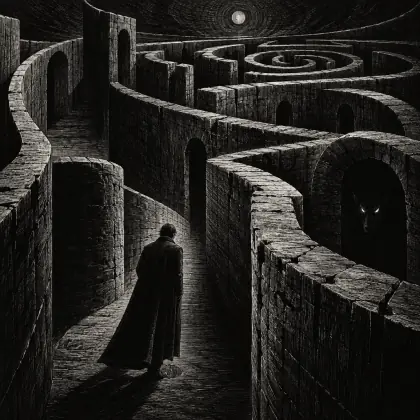
Borges presents the labyrinth not merely as a building but as a destiny that steadily erases personal identity. The speaker is enclosed by a web of stone
so absolute that even Zeus could not undo it. That claim makes the imprisonment feel stronger than divine power: the labyrinth is less a puzzle awaiting a solution than an irreversible condition of existence. Its most disturbing effect is inward. The speaker has forgotten the men I was before
, a phrase suggesting that he has already lived through several vanished selves. He remains physically alive, but repetition has made his former identities inaccessible.
The Thread Has Become Stone
The opening image quietly reverses the familiar myth of Ariadne’s thread. A thread should lead someone out of the Cretan labyrinth, but here the maze itself is a web
, and its woven material is stone. The verb undo
also belongs to cloth or thread, as if escape would require the whole structure to be unstitched. Later, the solitudes weave and unweave this Hades
, extending that language from architecture to time and consciousness. The prison is continually made and remade by the lives inside it.
This reversal matters because no Ariadne appears, and no thread points toward an exit. Instead, the speaker follows the hated path
through walls that bend in secret circles
. Movement offers no progress; walking only renews imprisonment. Even the damaged parapets provide no hope. They are cracked by the days’ usury
, a striking description of time as a lender collecting interest. The years wear down the stone, but they also exact payment from the prisoner. Ruin does not necessarily mean liberation.
Signs Without Meaning
The labyrinth reduces knowledge to fragments. In the dust, the speaker sees signs that frighten me
, but he cannot interpret them with certainty. Likewise, he hears either a roar or the echo of a desolate howl
. The distinction is crucial but unavailable: a roar suggests an approaching beast, while an echo may be only the maze returning an old sound. The speaker knows that something is present, yet the labyrinth prevents him from knowing where it is, how near it is, or even whether the sound is immediate.
The phrase concave evenings
deepens this sense of enclosure. Evening is usually a time, not a shape, but here it curves inward like the galleries. The labyrinth has absorbed the sky and the hours into its architecture. Everything bends back toward the speaker. The tone is therefore fearful but also exhausted: terror has lasted so long that it has become monotonous.
The Other in the Shadows
The poem’s central turn comes with the declaration, there is an Other
. At first, the speaker seems utterly alone; now solitude becomes a shared condition. Myth invites us to identify the two figures as Theseus and the Minotaur, yet Borges avoids fixing the speaker securely as either one. The Minotaur is the labyrinth’s traditional captive, while Theseus is the intruder who seeks him. But the poem gives both figures parallel destinies: each wanders, waits, and seeks the other through darkness.
This uncertainty weakens the usual distinction between hero and monster. The Other supposedly longs for the speaker’s blood and will devour my death
, language that makes him sound monstrous. Yet a killer can metaphorically consume another person’s death, and Theseus enters the maze precisely to shed blood. Conversely, the trapped Minotaur may be less an active predator than a creature sentenced to wear out the long solitudes
. The labyrinth makes both inhabitants frightening because it makes each unknowable to the other.
Enemies Bound by the Same Need
The poem’s sharpest contradiction is that the two figures are mortal enemies but also the only possible answer to each other’s loneliness. Each of us seeks the other
: their pursuit is reciprocal, almost intimate. Each gives the other a direction in a place where direction has otherwise lost meaning. Without the enemy, there would be only walls, dust, and repeated paths. The anticipated violence is horrifying, but it is also the one remaining event capable of breaking monotony.
This makes the Other resemble a hidden double. The speaker’s forgotten earlier selves, the ambiguous noises, and the circling passages all destabilize his sense of separateness. Perhaps what frightens him is not only being killed, but discovering in the shadows another prisoner shaped by the same maze. Their opposing roles may be less important than their shared condition: both are caught in a story that demands a meeting and a death.
The Desired Final Day
The last wish—the final day of waiting
—changes the poem’s fear into grim longing. The speaker does not explicitly wish to defeat the Other. He wishes only for waiting to end. Victory, murder, sacrifice, and death remain deliberately unresolved, because any conclusion may feel preferable to endless anticipation. The labyrinth’s deepest cruelty is therefore not that it contains a monster. It turns death into a possible form of release, and an enemy into the only being who can provide it.
Feel free to be first to leave comment.