
Analysis of Lines Composed And Written In An Edition Of The Saga Of Beowulf
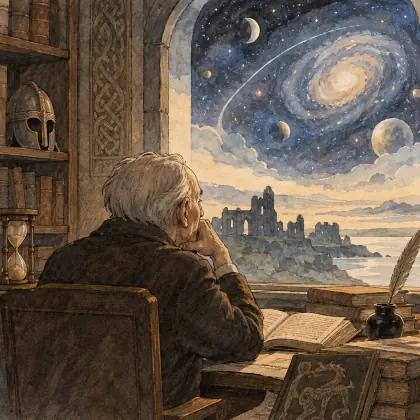
A Study Without Hope of Mastery
Borges begins with an apparent contradiction: he continues studying Old English even though he no longer expects accuracy
. The work is painstaking and almost punitive; he must grind on
with the language of the flinty Saxons
. That adjective makes the Saxons and their words seem hard, ancient, and resistant, as if learning the language meant striking against stone. Yet the poem’s central claim is that such seemingly futile effort expresses something fundamental about the human soul: it reaches beyond age, failure, and death because it secretly believes that nothing is finally beyond its grasp.
Memory Rehearses a Failing Life
The speaker’s difficulty is not merely intellectual. His memory, worn down by time
, now fumbles with words
he has repeated many times. Study therefore becomes a measure of personal decline. What once might have been retained now slips away, and the speaker recognizes his whole life in that process. His memory resembles a life that spins and then unspins
its own story: experience accumulates, but age begins to undo the pattern. The image suggests a thread or woven fabric being pulled apart, so that the self cannot permanently preserve what it has made.
The reference to approaching darkness
carries particular weight because Borges became blind. Here darkness is at once literal blindness, old age, and death. That context sharpens the pathos of his persistence: the scholar continues working with a written language while his access to written pages is disappearing. Yet the poem does not ask us simply to admire heroic perseverance. The opening question remains genuine. Why labor at something when memory fails and perfect knowledge is no longer possible?
The Soul’s Arrogant Answer
The decisive turn arrives with And then I tell myself
. The speaker answers his doubt not through practicality but through metaphysics. He imagines that the soul continues because, in its secret, arrogant way
, it knows itself to be immortal. The word arrogant
complicates the affirmation. The soul’s confidence may be sublime, but it may also be a form of pride: an unwillingness to accept human limitation. Its huge, determined circle
aims to embrace and accomplish everything, even though the aging individual cannot reliably remember a vocabulary he has repeatedly studied.
This creates the poem’s deepest tension. The speaker is plainly limited, yet something within him behaves as if it were limitless. His continued study can be read as evidence of immortality, but also as the touching self-deception of a mortal mind. Borges does not settle the question. By saying I tell myself
, he leaves open whether immortality is a truth the soul recognizes or a consoling story the speaker constructs. The soul knows
, but the conscious man can only wonder.
Beowulf and the Inexhaustible Universe
The closing lines enlarge the poem’s scale abruptly. Old English study, personal yearning, and even Borges’s verse are surpassed by the universe, which waits inexhaustible
. That final word answers the earlier images of exhaustion: memory is worn down, life’s story flags, and the speaker’s powers diminish, but reality itself does not run out. The universe waiting for me
can suggest death and whatever lies beyond it, yet it also names the endless field of knowledge still available to the living mind.
The ending is therefore hopeful without becoming reassuring. The speaker will never master the Saxon language or complete the soul’s vast circle. What matters is that he continues moving toward what exceeds him. His worn memory and the inexhaustible universe stand opposite one another: one loses words, while the other offers more than any mind can contain. In that imbalance, Borges finds both the sadness and the grandeur of study. Learning matters not because it can be finished, but because the desire to know refuses to accept that the self’s present limits are its final boundary.
Feel free to be first to leave comment.