
Analysis of A Milonga For Manuel Flores
A Man Speaking of Himself as Another
The poem presents death as both ordinary and impossible to comprehend. Its central tension lies between Manuel Flores’s practiced fatalism and his intimate attachment to existence. At first, the speaker names himself from a distance: Manuel Flores is going to die
. The declaration sounds like public news or the opening of a folk ballad, especially when followed by the blunt assurance that this prediction is on the money
. Yet the third-person distance soon collapses. Manuel begins speaking as I, revealing that the confident refrain conceals a frightened, bewildered consciousness.
The Habit That Still Hurts
The claim that Dying is a habit
gives death an almost comic familiarity. Everyone before Manuel has done it; in that sense, death is routine rather than exceptional. But the next stanza quietly rejects the emotional comfort of that thought. Despite death’s universality, it grieves me
to leave being itself, which is described as familiar
, sweet
, and enduring
. The contradiction is the poem’s emotional core: knowing that death is common does nothing to make one’s own disappearance feel natural. Manuel can accept the logic of mortality without being able to accept the loss of the world he inhabits.
Hands Becoming Strangers
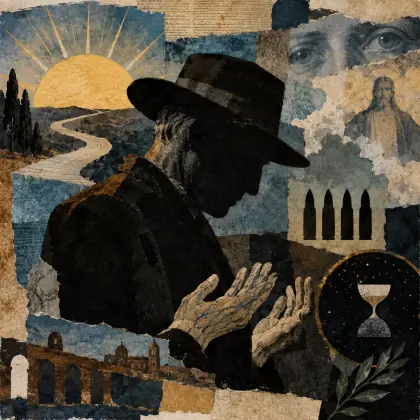
The most unsettling moment arrives at dawn, when Manuel looks at his hands and veins. These are not abstract symbols but the visible proof of his living body. Yet he says they seem as if they were strangers
. Because he knows he will soon die, his body has already begun to feel detached from him, almost like an object he is preparing to abandon. The hands remain alive, threaded with blood, but Manuel can no longer fully recognize them as his own.
This estrangement also suggests the limit of self-knowledge. Manuel can inspect the physical signs of life, but he don’t understand
them. The plain grammar matters less as characterization than as emotional directness: this is not a philosopher calmly explaining mortality, but a doomed man discovering that his own existence has become mysterious.
Four Bullets, Merlin, and Christ
The poem places exact foreknowledge beside radical uncertainty. Manuel knows that four bullets will come
tomorrow. The number makes his death brutally concrete, as though the event has already been counted out. Yet what follows those bullets is less secure. He calls it oblivion
, but he also imagines Christ judging him and wonders what his eyes will see afterward. Oblivion implies that consciousness ends; judgment implies that some part of Manuel survives. The poem does not resolve this contradiction because Manuel himself cannot.
Merlin’s pronouncement, To die is to have been born
, turns mortality into destiny: birth already contains death. But that wisdom is almost too neat for Manuel’s situation. It explains why he must die without explaining what dying will feel like or what, if anything, comes next. Likewise, the reference to Christ introduces moral judgment, but Manuel does not ask whether he will be saved or condemned. His question is more elemental: after his eyes have seen so many things
along the road, will they see anything beyond death?
The Ballad Closes Over the Fear
The return of the opening stanza restores the impersonal, public voice: Manuel Flores is once again a named figure whose death can be sung about. This repetition does not erase the private confession between the refrains; it makes that confession more poignant. Outside, death is a familiar event and a suitable subject for a milonga. Inside the doomed man, however, it remains incomprehensible. The poem’s tough, colloquial tone therefore carries a concealed tenderness: Manuel can face four bullets, but he cannot stop grieving the sweetness of simply being alive.
Feel free to be first to leave comment.