
Analysis of New England 1967
A Landscape That Enters the Dream
The poem presents travel not as escape from home but as a strange deepening of attachment to it. New England has altered even the speaker’s unconscious: forms in my dreams have changed
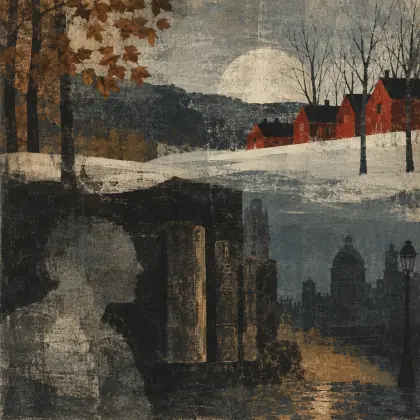
. Red houses, bronze leaves, and winter woods have replaced whatever images once occupied his sleep. Yet these details do not produce a simple sense of arrival. The speaker can see America clearly, but Buenos Aires remains the city through which his inward self moves. The poem’s central tension is therefore between physical location and imaginative presence: the body is in New England, while memory continues to inhabit Argentina.
Winter Given a Moral Character
The opening landscape is not merely picturesque. Its chaste winter
and pious wood
give nature the moral vocabulary of New England’s Puritan inheritance. Even the neat red houses standing side by side
suggest order, restraint, and communal discipline. The leaves are described as delicate bronze
, a phrase that combines fragility with the dignity of an old monument. New England appears beautiful because it seems both natural and historical: the season, architecture, and religious past have blended into a single atmosphere.
The Good World and Its Dark Murmur
The poem then makes its boldest affirmation: the world / is good
, as it was on the seventh day of creation. The biblical reference gives the autumn evening a momentary completeness, as though the speaker were looking upon a finished world and consenting to it. But that goodness is immediately complicated. In the twilight there remains an ancient murmur
of Bibles, war
. Scripture and violence are compressed into the same lingering sound. Faith may have helped build this world, but conflict belongs to its history as well.
The contradiction is not resolved, and that is crucial. The landscape can be good without being innocent. Its beauty includes something bold, sad
and nearly vanished: a past that can no longer be seen directly but still persists in the emotional texture of the place. Twilight suits this perception because it is an hour of partial disappearance. New England’s history is neither fully present nor fully gone.
Snow Ahead, Buenos Aires Behind
The expected first snow should carry the poem forward into a new season. Likewise, America waits
on every street, making the foreign country sound open and available. Yet the speaker’s attention turns away from this promised future. Evening brings a painful distortion of time: today so long
and yesterday so brief
. The present stretches because it is foreign and consciously experienced; the past contracts because memory can summon an entire life in an instant. Distance has not weakened Buenos Aires. It has made the city less ordinary and more inwardly intense.
The City Traveled Without Moving
The final address to Buenos Aires reveals the poem’s quiet turn. The speaker says he is journeying through its streets without time or reason
. This is not a planned recollection, nor necessarily a sentimental decision. Memory operates on its own, carrying him through a city absent from his surroundings but immediate to his mind. The ending therefore reverses the opening: New England enters his dreams, but Buenos Aires enters his waking perception.
The poem finally suggests that belonging is not determined by the scenery directly before us. America may wait outside on every street, yet the deepest journey occurs elsewhere, beyond chronology and explanation. The traveler discovers that a new landscape can possess his imagination without displacing the old city that possesses him.
Feel free to be first to leave comment.