
Analysis of Odyssey Book Twenty Three
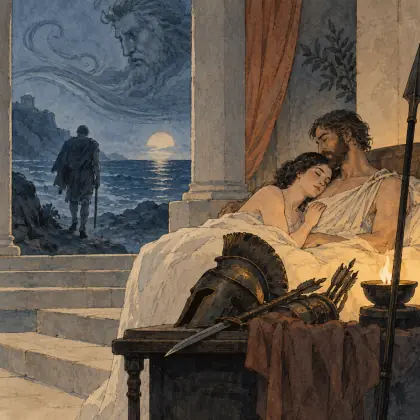
Who Comes Home When Ulysses Returns?
Borges begins where an epic might end: the enemies have been killed, the kingdom recovered, and the marriage restored. Yet the poem’s real question is not whether Ulysses has returned, but what has happened to the person formed by his absence. The final lines turn victory into an identity crisis. Once the wanderer becomes king again, the poem asks, where now the man
who survived by exile, disguise, and namelessness? Homecoming fulfills Ulysses’s desire, but it may also extinguish the self who desired it.
The Bloody Certainty of the Epic
The opening sounds ceremonially conclusive. The sword has completed its rightful task of vengeance
, while arrows and lance have spilled the blood of the evil one
. This language divides the world cleanly into rightful ruler and guilty enemy. At the same time, Borges makes that justice physically disturbing: its instruments are iron, sharp, and bloodstained. The triumph is legitimate within the heroic story, but it remains slaughter. The repeated now
insists that the long postponement is over, as though each settled fact were being entered into a final account.
Ulysses’s return also appears to defeat the forces that kept him wandering: a god and all his seas
, the grey winds, and the clamour and din of Ares
. Sea, weather, divinity, and war are compressed into obstacles that the hero has overcome. The tone is elevated and public; Ulysses is once again attached to stable possessions and roles—his realm and queen
. But this restored order depends on forgetting how unstable he had to become in order to reach it.
The Bed Where the Story Should End
The poem then moves from weapons and uproar to the marital bed. Penelope is no longer surrounded by suitors or uncertainty; she is fast asleep
, her head resting on her husband’s breast. The image promises peace, intimacy, and recognition. Yet Borges introduces a slight estrangement in the phrase this, her king
. Ulysses is present and identified, but the wording almost points at him from outside, as though the familiar title cannot completely account for the man lying there.
This is the poem’s decisive turn. Penelope’s sleep suggests that the ordeal has reached closure for her, while the questioning voice remains awake. The bed restores the marriage, but it cannot reconcile all of Ulysses’s identities: warrior, exile, beggar, liar, husband, and king. The scene is therefore both tender and unsettling. Love gives him back his proper name, but that recovery carries a hidden loss.
The Man Called No One
The closing description strips away the victorious king. Borges remembers the man banished from his home
, roaming by day and night
, reduced to a dog
. Most importantly, he recalls the name Ulysses gave himself before the Cyclops: No One
. In Homer, that false name is a brilliant survival tactic. Here it becomes something larger—the emblem of a self without rank, home, or fixed identity.
The final question has no easy answer. The wanderer has not literally vanished; he lies beside Penelope. But the public identity of king may conceal him as effectively as the name No One
once did. Borges thus makes fulfillment paradoxical: Ulysses can return only by ceasing to be the homeless man who struggled to return. The poem closes not with the comfort of arrival, but with the suspicion that every recovered life leaves another life behind.
Feel free to be first to leave comment.