
Analysis of Oedipus And The Enigma
The Answer Becomes the Riddle
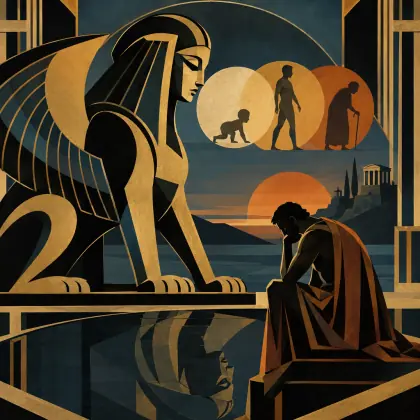
Borges retells the encounter between Oedipus and the sphinx so that solving the famous riddle is no longer a triumph of intelligence. It is an unbearable act of self-recognition. The creature described as four-footed at dawn, upright by day, and three-footed in the evening represents a human being crawling in infancy, walking in adulthood, and using a staff in old age. Yet Borges’s central claim is stranger and darker: human beings can survive only because they experience these stages one at a time. To see the whole pattern at once would expose each life as a predetermined movement toward decline.
The Sphinx’s Inconstant Brother
The opening reverses the usual relationship between monster and man. The sphinx is eternal
, while Man is her inconstant brother
. Calling them siblings weakens the comforting division between the human and the monstrous. The sphinx is not simply an alien threat; her composite body gives visible form to the changing human body. She remains fixed while containing infancy, maturity, and old age all at once. Man, by contrast, must pass through these identities successively and therefore experiences himself as continuous and singular.
The progression from dawn to day and then through evening’s emptiness
turns an ordinary lifespan into the passage of a single day. That compression is frightening because it makes change feel both rapid and inevitable. Evening is not merely old age but an emptiness through which the three-footed figure wanders. The added walking stick may increase stability, yet it also marks the body’s loss of independence. The riddle’s answer, then, is not just Man; it is man understood as an unstable succession of bodies.
Horror in the Mirror
The poem turns when Oedipus arrives towards sun set
. In the myth, he demonstrates mastery by identifying the creature in the riddle. Here, however, his insight comes with horror
. The sphinx’s monstrous image’s mirror
reflects his own decline and fate
. Knowledge collapses the boundary between interpreter and object: Oedipus understands the beast only by recognizing himself inside it. His later fate gives this moment an added force. The man celebrated for seeing the answer will become blind, aged, and dependent—the evening figure already latent within the victorious adult.
Oedipus We Are
Borges then moves from one legendary man to everyone: Oedipus we are
. The phrase does not chiefly mean that all people share Oedipus’s particular crimes. It means that each person is both the solver of the human enigma and the creature described by it. We are the elongated, triple beast
because our identity stretches across incompatible states: helpless child, capable adult, declining elder. The tension lies between our sense that we are one person and the grotesque composite that appears when all our ages are mentally superimposed.
The poem even suggests that complete self-knowledge may be fatal. If infancy and old age are equally present in the self, then adult strength is only a temporary appearance; the crawling child and the supported wanderer never truly disappear. To comprehend that entire figure at once would mean viewing one’s life almost from outside time—and seeing death already embedded in birth.
Forgetfulness as Mercy
The final line makes a startling theological claim: God is merciful not because he explains our fate, but because he conceals it through duration. Time lets us forget
, separating what we were from what we will become. Forgetfulness, usually treated as a weakness, becomes a condition of endurance. The ending therefore shifts from horror toward a severe kind of consolation. Human beings are spared not from decline but from continuously perceiving its total design. Borges transforms the sphinx’s enigma into a truth about consciousness: we live because time prevents us from seeing ourselves whole.
Feel free to be first to leave comment.