
Analysis of One Of Urbinas Soldiers
The Soldier Who Cannot See the Author
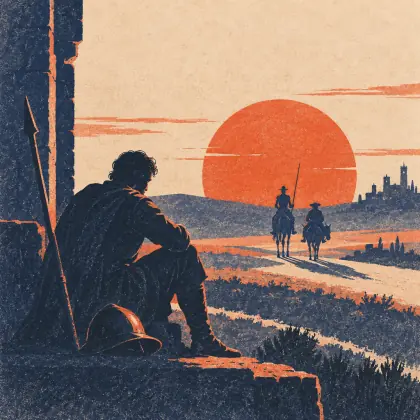
Borges presents Miguel de Cervantes at a moment when his life appears to have narrowed into failure, while his greatest creative achievement remains invisibly close. The title identifies him only as one of Captain Diego de Urbina’s soldiers, under whom Cervantes served at the Battle of Lepanto. Yet the final appearance of Don Quixote and Sancho reveals who this obscure veteran will become. The poem’s central irony is that the soldier considers himself undone, alone and poor
even as an entire imaginative world waits for him to recognize and shape it.
After Courage, Menial Survival
The opening separates past heroism from present uncertainty. The soldier doubts whether he could ever again be as brave as he was at sea
. Courage belongs to a completed episode; afterward come menial tasks
, solitude, and wandering through the hard land of Spain
. Borges does not romanticize the veteran’s return. The landscape seems to reproduce his inward condition: hard, exposed, and unrewarding.
This creates the poem’s first important tension. Cervantes has already performed the kind of martial bravery celebrated in heroic stories, but that bravery has not given him a heroic life. He is merely one soldier among others, burdened by poverty and doubt. The title reinforces this apparent anonymity: history has not yet distinguished him from Urbina’s other men.
Romance Against the Copper Glare
The soldier turns toward old tales because he wants either to shun the world’s brutality
or to soften it
. That hesitation matters. Literature may be an escape from violence, but it may also be a way of transforming violence into something the mind can endure. The stories of Roland and Brittany offer heroic grandeur, magic, and an ordered past. Against them stands the Spanish plain under the sunset’s relentless copper glare
. Copper suggests both beauty and hardness: the landscape glows, but its light remains metallic and punishing.
Yet Cervantes will not simply reproduce the romances that console him. Don Quixote will carry their heroic ideals into a world of poverty, ordinary labor, bodily pain, and ridicule. The poem therefore places him between incompatible realities: the sublime world he seeks and the harsh country he inhabits. His future art will arise precisely from that collision. Don Quixote’s grandeur cannot be separated from his absurdity, just as Cervantes’s imagination cannot be separated from deprivation.
A New Kind of Command
The decisive turn comes with the phrase music that awaited his command
. Earlier, command belongs implicitly to military life; here Borges converts it into artistic authority. Cervantes may no longer command his circumstances, but he will command language, rhythm, character, and narrative. Calling the unwritten work music
also suggests that creation is already latent within him, waiting to be released rather than manufactured from nothing.
The word unaware
sharpens the irony. Cervantes does not know what the poem knows: his loneliness is not empty, and his wandering is already becoming material for art. Borges even makes Don Quixote and Sancho seem partly independent of their creator. The soldier sees them riding out while moving through some deep dream
, as though the characters already exist and are approaching the man who must write them.
The Quest Hidden Inside Defeat
The ending quietly reverses the soldier’s judgment of his life. He thinks he has been undone, but the vision of the two riders suggests that his true quest is only beginning. The tone shifts from resignation and oppressive loneliness to enchantment, though without erasing hardship. Poverty, failed heroism, romance, and the severe Spanish landscape all enter the dream from which Don Quixote will emerge. Borges’s deepest claim is that creative destiny may be nearest when it is least visible: the forgotten soldier wandering alone is already accompanied by the figures who will make him immortal.
Feel free to be first to leave comment.