
Analysis of Poem Of The Gifts
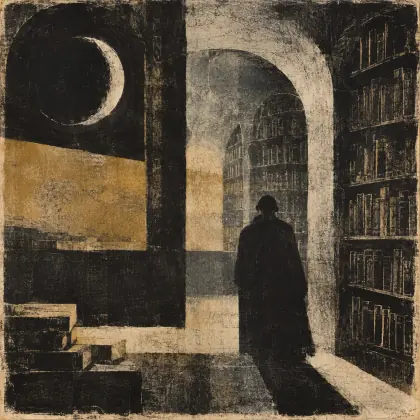
The Gift That Is Also a Punishment
The poem turns Borges’s blindness and his access to an immense library into a single, cruelly perfect gift. Its governing contradiction appears immediately: God has given him books and the night
at the same time. Books promise knowledge, imaginative freedom, and paradise; blindness makes their contents inaccessible. Yet the speaker asks that no one respond with tears or a reproach
. His tone is neither self-pitying nor simply grateful. Instead, he regards the coincidence with grave, almost religious wonder, calling it sublime irony
. The phrase allows pain and admiration to coexist: the design is devastating, but so exact that it seems to display a mysterious intelligence.
Lightless Guardian of the Books
The irony becomes sharper because the speaker has been given guardianship
over a city of books
. This refers directly to Borges’s appointment as director of Argentina’s National Library in 1955, by which time his eyesight had severely deteriorated. The library is imagined not as a room but as a city, a cosmos large enough to contain centuries, dynasties
, symbols, atlases, and accounts of creation. The speaker governs this abundance while being unable to enter it fully.
His eyes can still decipher only senseless passages
, as though reading had become indistinguishable from dreaming. Daylight continues to offer him infinite books
, but does so in vain
. Abundance therefore intensifies deprivation rather than relieving it. Each visible but unreadable volume becomes evidence of what has been withheld.
Tantalus in the Library
The Greek king dying of hunger and thirst among fountains and gardens
is Tantalus, condemned to remain beside food and water he cannot reach. Borges recasts the National Library as an intellectual version of that punishment. The speaker is surrounded by nourishment for the mind, yet cannot consume it. Even the catalog of encyclopedias, maps, histories, and cosmologies becomes oppressive: these books afford us the walls
. What should open the universe instead encloses him.
This reversal explains why the library is both dear
and a blind vault
. It remains his imagined paradise, but paradise has acquired the qualities of a tomb. The manuscripts lost at Alexandria deepen the tension. Those ancient works were destroyed physically; the books around Borges still exist, but for him they undergo a private destruction. Their presence is almost as unreachable as their absence.
The Tottering Priest of a Hollow Paradise
As the speaker moves through the galleries, his identity changes from director to frail pilgrim. He advances slow by my shadow
, carrying a tottering crosier
. A crosier is associated with religious authority, but here it also suggests the cane of a blind man. Borges’s position grants him ceremonial mastery over the library while his body makes him dependent and uncertain. He is simultaneously ruler, priest, prisoner, and supplicant.
The line about having imagined paradise as a library is therefore more than a familiar tribute to books. It is a confession that his deepest desire has been granted in a form that defeats itself. The poem’s most unsettling possibility is that fulfillment and punishment are not opposites. The same library can answer his lifelong longing and expose the impossibility of satisfying it.
Groussac and the Return of the Same Fate
The poem’s decisive turn comes when private misfortune begins to look like repetition. Walking the slow galleries
, Borges feels sacred horror
that he is another man who previously lived the same destiny. Paul Groussac, named in the final stanza, had also directed Argentina’s National Library and also became blind. This parallel makes coincidence feel like a pattern imposed by an unnamed power.
The speaker refuses to identify that power precisely. It is certainly not random fate
, but it is not confidently called providence either. The opening invocation of God’s mastery
gradually gives way to something unnamed
. That shift darkens the tone. At first, the speaker can frame his condition as divine irony; later, he confronts a design whose author and purpose remain unknowable.
One Shadow, Two Authors
The encounter with Groussac destabilizes the speaker’s sense of individuality. He asks who is writing the poem when the self has become plural
but casts just one shadow
. The question is not merely whether Borges resembles Groussac. It is whether repeated circumstances reduce both men to versions of a single role: the blind guardian wandering among unreadable books.
This is why the name that convok[es]
the speaker finally seems unimportant. Whether the name is Groussac or Borges, the anathema
remains one and indivisible
. Authorship itself becomes uncertain. Borges is writing the poem, but Groussac’s earlier life seems to speak through him; the individual voice is haunted by a predecessor who has already enacted its words.
The World Fading into Ash
The final image does not resolve the divine irony. Instead, the visible world distort[s]
and dies into pale, vague ash
. Blindness is represented not as sudden blackness but as gradual erasure, close to slumber and oblivion
. The ending widens the poem beyond eyesight: both men are moving toward the loss of the world, the loss of identity, and finally death.
Yet the poem itself complicates that disappearance. Borges cannot freely read the books surrounding him, but he can still transform their inaccessible abundance into language. The library has become shadow, wall, and tomb; through the poem, however, those conditions become intelligible. The gift remains cruel, but not empty. Out of a world fading toward oblivion, the speaker makes an enduring account of what it feels like to watch knowledge remain present while sight, selfhood, and certainty slowly recede.
Feel free to be first to leave comment.