
Analysis of A Poet Of The Thirteenth Century
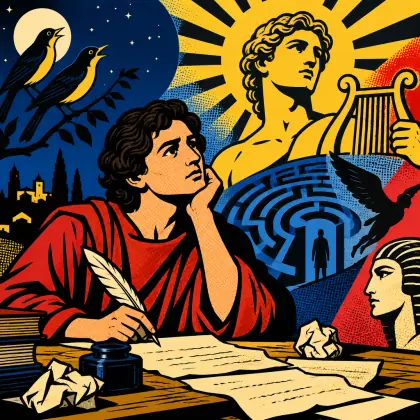
The Pause That Becomes a Revelation
Borges imagines an unnamed medieval poet correcting what may be the first sonnet, unaware that he is standing at the beginning of a vast literary tradition. The poem’s central claim is that artistic invention can feel less like making something new than discovering something that has always existed. Its decisive moment comes when the poet pauses
: ordinary revision opens suddenly onto metaphysical awe. The sonnet is no longer merely an arrangement of lines but an archetype, a timeless form capable of containing the world.
A Craftsman Before He Is a Visionary
The opening keeps the poet’s work modest and physical. He examines drafts he struggled with
, notices how carelessly he has mixed tercets and quatrains
, and corrects the poem with a slow pen
. Nothing here resembles effortless inspiration. The sonnet emerges through dissatisfaction, judgment, and patient labor. Even its name does not yet exist: it is still to be named
. Borges therefore places us at a peculiar historical threshold, when a form familiar to later readers remains uncertain even to its maker.
There is gentle irony in the poet’s concern that he has been flouting good taste
. He judges himself by standards that already seem established, yet he may actually be establishing a new standard. What looks to him like roughness or error may be the first appearance of a form that later poets will treat as inevitable.
The Nightingales of the Future
After the pause, the tone shifts from quiet craftsmanship to wonder touched by fear. The poet may have heard distant singing of nightingales
, a sound that can be read as the voices of poets who will use the sonnet after him. The singing is distant not only in space but in time. For one instant, the medieval writer seems to overhear the future tradition his experiment will make possible.
Yet this glimpse is described as both a portent
and a holy terror
. Beauty is not comforting here. To encounter a form larger than oneself is frightening because it weakens the idea of individual authorship. The poet may be writing the sonnet, but the sonnet also appears to be choosing him as the person through whom it will enter history.
A Form Hungry for Everything
Apollo, god of poetry, reveals an archetype described as unclouded, voracious
. Those two qualities create the poem’s sharpest contradiction. The form is clear and bounded, yet also ravenous: it can absorb whatever night conceals
and whatever day reveals
. Fixed shape does not restrict meaning; it gives meaning a vessel capable of receiving both obscurity and knowledge, dream and reason.
The closing sequence—Daedalus, labyrinth, enigma, Oedipus—demonstrates that capacity. Daedalus represents invention, the labyrinth bewildering complexity, the enigma a demand for interpretation, and Oedipus the terrible cost of solving what is hidden. Together they suggest that poetry does not simply decorate experience. It constructs mysteries and enters them, seeking knowledge that may be dangerous.
The Anonymous Beginning
Borges never identifies the poet, and the questions Did he perhaps
and Will he have felt
preserve the scene as speculation. That uncertainty matters. The poem is less interested in assigning historical credit than in imagining the instant when private labor touches something impersonal and enduring. Its final wonder is that a writer correcting an awkward draft may unknowingly create a home for centuries of thought, music, fear, and mystery.
Feel free to be first to leave comment.