
Analysis of Remorse
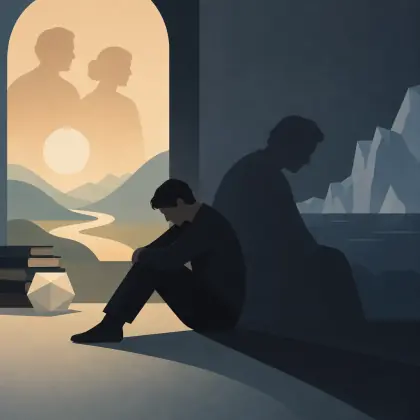
Unhappiness Put on Trial
Borges’s speaker treats unhappiness not as a misfortune but as a moral offense. His opening claim—the worst of sins
—is deliberately startling because happiness is not usually considered a duty. Yet the speaker judges himself as though he freely rejected the world offered to him. The poem’s central tension lies here: he assumes responsibility for a state of mind that may never have been under his control. Remorse therefore becomes both sincere and cruel, an act of self-examination that turns into self-punishment.
The Glaciers of Oblivion
The desired punishment is not correction or forgiveness, but erasure. The speaker asks the glaciers of oblivion
to engulf him mercilessly
. A glacier suggests enormous, impersonal coldness: it covers the past slowly and completely, preserving what it buries while also removing it from sight. This is appropriate to a remorse that never leaves
him. He wants oblivion because memory continually renews the charge against him.
There is also a revealing mismatch between the supposed crime and the severity of the sentence. He has harmed no named person and committed no concrete act of violence. His offense is simply that he was not happy
. By demanding merciless extinction for this, the speaker shows how melancholy distorts judgment: unhappiness becomes evidence of guilt, and guilt then deepens unhappiness.
The World His Parents Intended
The poem’s emotional center arrives when the speaker imagines his parents’ hopes. They brought him into the beautiful game of life
, a game that is also risky
. That pairing matters. His parents did not expect safety or ease; they expected participation—an openness to danger, beauty, and experience. The elemental list of earth, water, air and fire
enlarges their gift until it includes the whole physical world. Against that abundance comes the blunt refrain: I was not happy
.
His grief is therefore not only private. He believes he has failed the younger versions of his parents, whose hope remains unfulfilled
. But this belief may itself be an invention of remorse. The poem never tells us that the parents accused him. The accusation comes entirely from the speaker, who converts their love and hope into standards by which to condemn himself.
Art as Refuge and Failure
The sharpest self-criticism is directed at the life of the mind. Instead of accepting the risky game, the speaker says he devoted himself to the symmetric arguments of art
and its web of trivia
. Symmetry offers order, while a web suggests entanglement and enclosure. Art may create beautiful patterns, but here it also becomes a shelter from direct experience—a way to analyze life rather than inhabit it.
This judgment contains a striking contradiction: the poem condemns art through an accomplished work of art. Its elemental images, measured statements, and repeated confession all belong to the very pattern-making the speaker distrusts. Art may have failed to make him happy, yet it allows him to state his remorse with precision. What he calls trivial is also the means by which his pain becomes intelligible to another person.
The Shadow That Cannot Be Dismissed
The final movement shifts from happiness to courage: I was not brave
. This deepens the confession. The speaker now interprets melancholy as cowardice, as though bravery would have enabled him to embrace the world his parents offered. Yet the closing image complicates that verdict. The shadow of a melancholy man
stays constantly beside him. A shadow is inseparable from the body; it is not simply a bad choice that can be reversed.
The ending therefore leaves the speaker divided between accusation and recognition. He insists that he failed, but his shadow suggests an enduring temperament rather than a voluntary sin. The poem’s remorse is most painful because it demands that the speaker should have been someone other than himself. Its bleakness comes not merely from unhappiness, but from the belief that unhappiness betrays love, wastes existence, and deserves no mercy—even when it cannot simply be willed away.
Feel free to be first to leave comment.