
Analysis of A Rose And Milton
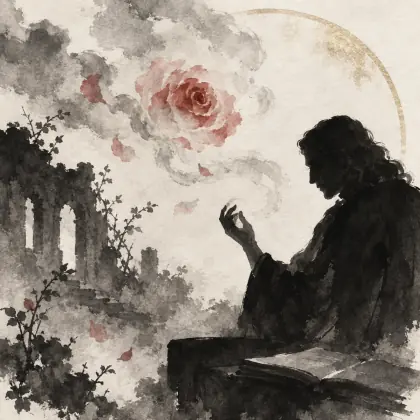
Saving What Cannot Be Recovered
The poem presents poetry as an act of preservation, but also as an act of invention. Its speaker reaches into the countless generations of roses
that have disappeared and asks to rescue one flower from the depths of time
. The ambition is deliberately impossible: no one can identify every rose that once existed, much less retrieve a particular one. Yet the poem claims that language can grant a lost object another kind of existence. The rose cannot return physically, but it can become permanent as the object of attention in a poem.
The Last Rose Before Milton
The speaker does not choose a famous rose associated with a public event. Instead, he imagines the last rose
that the English poet John Milton held before him. Milton’s blindness gives unseen
its precise force: the rose may have been physically near him, perhaps even in his hands, without entering his sight. This imagined moment joins intimacy with absence. Milton can touch the flower but cannot see it; Borges’s speaker can envision the scene but cannot know what the flower actually looked like.
That double distance creates the poem’s deepest tension. The speaker wants one spotless rose
, a single, exact object saved intact from oblivion. But he immediately lacks the information needed to make it exact. Was it vermilion, or yellow
, white, gold-colored, blood-colored, ivory-colored, or dark as shadow? The sequence of alternatives does not restore the historical rose. Instead, it displays the mind circling around an absence.
When Choice Becomes Creation
The poem turns when its language shifts from asking permission to directly addressing the flower: O vermilion
. At first, the speaker claims that Fate permits
him the gift of choosing. This makes poetic imagination sound almost supernatural, as if fate has briefly granted him authority over time. Yet what he chooses is not one stable color but several incompatible possibilities. The rose becomes richly visible to the reader precisely because its actual appearance remains unknowable.
This is the poem’s quiet paradox: preservation requires transformation. To save the rose, the speaker must release it from factual certainty and recreate it through a range of colors and materials. Gold, blood, ivory or shadow
turns the flower into something more symbolic than botanical. Gold suggests radiance and permanence; blood suggests life and mortality; ivory suggests purity; shadow returns the rose to darkness. These alternatives contain both the vividness of existence and the obscurity into which existence passes.
The Invisible Rose That Shines
The closing lines intensify the contradiction by saying that the rose forever shines
while also calling it an invisible rose
. It is invisible to Milton because of blindness, invisible to the speaker because centuries have intervened, and invisible to us because it survives only in words. Nevertheless, the poem gives it a durable imaginative presence. The phrase as if in his hands
carefully preserves the uncertainty: poetry cannot prove that the scene occurred exactly this way, but it can make the scene emotionally credible.
The tone therefore moves from elegiac longing to a restrained confidence. The opening mourns whole generations swallowed by time; the ending does not defeat oblivion so much as create a luminous counterimage to it. Borges’s rose survives not because its original color or garden can be recovered, but because its loss has been made unforgettable. The poem suggests that art preserves the past most powerfully when it acknowledges how much of the past remains beyond sight.
Feel free to be first to leave comment.