
Analysis of To A Saxon Poet
Brotherhood Without a Name
How can Borges call an unknown writer my grey brother
when he admits that he cannot recover the man’s face, name, or circumstances? That contradiction is the poem’s center. The Saxon poet has vanished as a historical person, yet his surviving words create an intimacy across centuries. Borges does not pretend that poetry defeats time completely. Instead, he presents literary survival as partial and severe: the poet remains present, but only through what he made.
Footprints the Country Has Forgotten
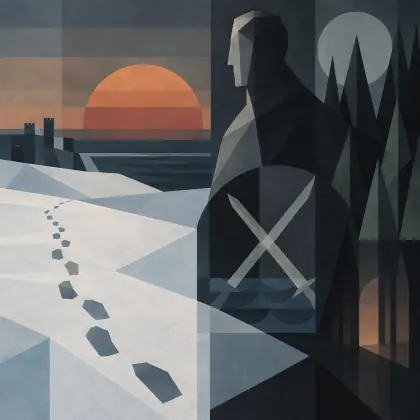
The opening image gives time a physical form. The Saxon once left a footprints’ trail
in Northumbrian snow, evidence of an actual body moving through an actual landscape. Yet Northumbria, which has often seen
those tracks, has now forgotten them. Snow already suggests impermanence: footprints can be distinct for a moment and then disappear under weather. The numberless
sunsets between the two poets deepen that erasure, making historical distance feel less like a measurable span than an accumulation too vast to count.
Even so, the phrase my grey brother
resists complete separation. Grey
may evoke age, shadow, winter, or the dimness of a figure seen through history. Brother
, however, is direct and affectionate. Borges claims kinship not through nation or blood but through the shared act of making poems. The unknown Saxon is remote in every biographical sense and close in the one sense that matters to the speaker.
Swords, Pines, and Daily Solitude
Borges imagines the vanished poet working in the slow shadows
, patiently fashioning metaphors. The subjects he assigns him are harsh: swords above the sea, terror among pine trees, exile, and solitude. These details create a world in which danger is both public and private. The crossed swords belong to travel, warfare, and heroic story; the horror at home
is stranger because home should offer safety. The pine forest becomes unsettling rather than protective, while solitude arrives not as one dramatic catastrophe but as something the days bring in
.
This imagined world also reveals the limits of imagination. Borges can infer the emotional weather of the poems, but he cannot move from those poems to certainty about their author. He can hear fear and loneliness in the surviving language without knowing precisely whose fear it was. Literature carries a voice forward while withholding the complete life behind that voice.
The Darkness Around the Man
The poem’s sharpest turn comes with the question, Where can one look now
for the poet’s features and name? The answer is nowhere: an already ancient darkness
conceals them. The phrase is striking because the darkness was ancient even before Borges approached it; oblivion has itself acquired an immeasurable past. His admission that he can never know just how things were
rejects the fantasy that sympathetic reading can fully resurrect the dead. The tone shifts here from imaginative closeness to sober humility.
Life Reduced to Iron
The closing couplet restores the Saxon poet in a transformed state. His earthly journey along roads of exile
has ended, but now you live only
in poems. The word only
makes this survival both miraculous and bleak. Poetry preserves him, but it also replaces him: body, face, and name are gone.
Calling the surviving works poems of iron
gathers the poem’s tensions into one final image. Iron belongs to the swords of the imagined Saxon world, but it also suggests hardness, endurance, and disciplined craft. Against melting snow, fading footprints, sunset, and darkness, iron seems permanent. Yet even this permanence is impersonal. What survives is not the whole man but the durable language he hammered into shape. Borges’s tribute is therefore less a claim that art conquers death than an acknowledgment of its austere bargain: the work can endure precisely where the maker can no longer be found.
Feel free to be first to leave comment.