
Analysis of Spinoza
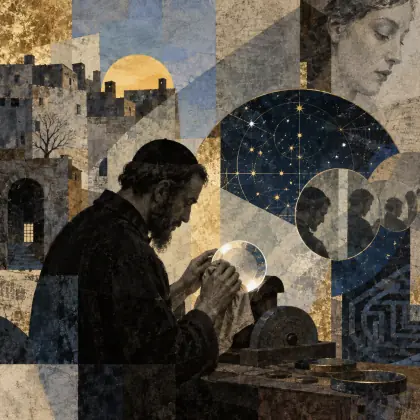
Light Made by the Hands
Borges presents Spinoza as a thinker whose ordinary manual labor opens onto an immense metaphysical vision. The poem begins in dimness: the philosopher works in half-light
, within a cold, dying afternoon. Yet his hands seem to glow
. That contrast establishes the poem’s central claim: Spinoza’s greatness does not depend on public glory or dramatic revelation, but on patient, almost invisible work. Grinding a physical lens becomes inseparable from clarifying how reality itself might be understood.
The Ghetto and the Maze
The visible world around Spinoza is narrow and repetitive. The afternoon is fear / and cold
, every day resembles the last, and ghetto walls
enclose the fading air. Borges draws here on basic facts about Baruch Spinoza: he was a seventeenth-century Jewish philosopher, expelled from Amsterdam’s Jewish community, who supported himself partly by grinding lenses. But the poem does not portray him primarily as a victim. He is impassive
, mentally absent from the walls around him because he is lost in that maze
of dreamed light.
The word maze
complicates the apparent serenity. Light usually suggests clarity, yet this light forms a labyrinth. Spinoza’s thought seeks a rational account of existence, but the totality he contemplates remains too vast to be simply or directly grasped. His calm is therefore not the calm of someone who has escaped difficulty; it is the concentration of someone dwelling inside it.
Fame as Another Mirror
At the poem’s turn, Borges moves from the circumstances surrounding Spinoza to the desires that no longer govern him. Fame is reduced to dreams’ reflection
inside yet another mirror
. Public reputation is not solid reality but an image of an image, dependent on other minds and therefore endlessly unstable. Erotic attachment is dismissed alongside it through the phrase fearful love
. The tone here becomes austere: Spinoza has withdrawn from ordinary forms of recognition, whether admiration from posterity or intimacy with another person.
That freedom has an uneasy edge. The philosopher’s lack of concern may indicate intellectual liberation, but it may also suggest emotional cost. His hands are vivid, while the man himself seems hardly / to be there
. Borges admires Spinoza’s selflessness, yet also makes him nearly vanish. To see reality as an all-encompassing unity may require surrendering the personal self that desires fame, love, and distinction.
The Metaphor That Denies Metaphor
The poem’s sharpest contradiction arrives when Spinoza is declared free from both myth and metaphor
. Immediately afterward, Borges describes his philosophy through an extravagant metaphor: the polished lens becomes an infinite Map
. This is not an accidental inconsistency. Spinoza’s rational system rejects a human-shaped deity and treats God as identical with the single, infinite substance of reality, often summarized as God or Nature. Yet Borges suggests that poetry cannot approach such a conception without lenses, maps, stars, dreams, and mirrors.
One Who Is All Stars
The final line breaks open the poem’s enclosed setting. The cold room, paling air, and ghetto walls give way to One who is all
the stars. The capitalized pronouns preserve religious grandeur, but this God is not a separate ruler looking down upon creation. He is the totality that includes every star and, by implication, the lens grinder, his hands, the walls, and the dying afternoon.
The lens is called intractable
because the vision it promises can never be made completely manageable. Spinoza polishes toward perfect understanding, but infinity cannot be reduced to a neat human picture. Borges ends by honoring both the ambition and the impossibility of that labor: within a small, darkened life, one man patiently attempts to make the whole universe intelligible.
Feel free to be first to leave comment.