
Analysis of The Sum
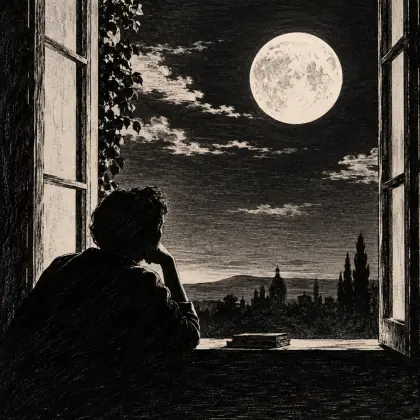
The Moon as Companion
The poem argues that ordinary familiarity conceals a finite number of encounters. The moon seems permanently available, a presence whose silent friendliness
has accompanied the addressed person since childhood or youth. Yet this companionship is not truly continuous. It consists of separate moments, and fate has already determined their total. By asking the reader to look closely now, Borges turns a familiar night sky into a reminder that any repeated pleasure may end without announcing itself.
A First Sight Lost in Time
The poem begins by imagining the first time the person consciously recognized the moon. The exact occasion has vanished: it was a night or evening lost
, in a garden or patio
that has itself turned to dust
. What remains is not the setting but the lasting bond formed there. The child’s or young person’s restless eyes
are said to have deciphered her forever
, as if seeing the moon were also an act of reading. That language makes perception intimate and intellectual at once: the moon becomes something known, interpreted, and absorbed into memory.
The parenthetical reference to misquoting Virgil
adds another layer to this intimacy. The speaker’s moon is partly inherited from literature; even a private encounter carries traces of earlier words. But the admission of misquotation also keeps the tone modest and conversational. The moon is not presented as a remote emblem requiring scholarly precision. She is a companion whose meaning has passed through books, memory, and imperfect recollection.
The Terrible Meaning of Forever
The poem turns sharply on the single question Forever?
Until then, permanence has seemed comforting: the moon was deciphered once and possessed for all time. The question exposes that confidence as an illusion. The speaker imagines a future person able to announce that the final sighting has already occurred: You’ll never see
the moon again because the allotted sum of moments
is complete. The title therefore carries a chilling mathematical force. A life is not merely a flowing duration; it is an account containing a fixed, though unknown, quantity of experiences.
The most painful detail is that abundance cannot undo completion. Opening every window in the world
would be useless. Windows normally promise access and renewed vision, but here even infinitely multiplied opportunities arrive too late
. The poem’s central contradiction lies in this clash between recurrence and finitude: the moon reliably returns, yet an individual’s access to it does not. The moon’s brightness continues; what ends is the observer’s capacity to meet it.
Discovering, Forgetting, Looking Again
The final movement broadens the idea beyond the moon. Human beings live by discovering and forgetting
the night’s sweet familiarity
. We repeatedly recover wonder, then let repetition dull it. This is not simply forgetfulness of facts; it is forgetfulness of value. Because the moon seems certain to return, attention weakens precisely where love and mortality should sharpen it.
The closing command, Take a long look
, is gentle rather than panicked. The tone has moved from affectionate reminiscence, through a stark prophecy of loss, to a restrained urgency. It might be the last
does not claim that death or blindness is imminent; uncertainty is enough. The poem asks for attention without offering control. We cannot know the number assigned to us, change the sum, or recognize the final term in advance. We can only look as though familiarity were precious—which, once its hidden limit is understood, it becomes.
Feel free to be first to leave comment.