
Analysis of Things That Might Have Been
An Archive of What Never Existed
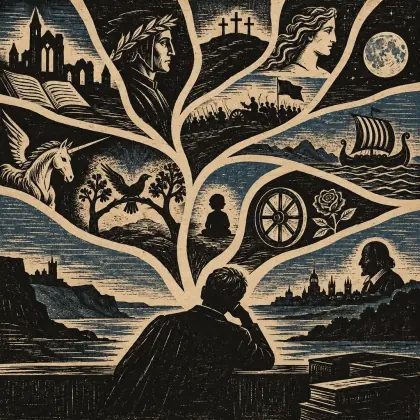
Borges treats unrealized possibilities not as empty fantasies but as a shadow archive beside actual history. The poem gathers unwritten books, altered battles, undiscovered worlds, impossible animals, and unlived relationships into one mental collection. Its central paradox is that these things do not exist, yet become briefly present through being named. Bede’s nonexistent treatise and Dante’s inconceivable work
acquire almost the same imaginative weight as works those writers actually produced. The poem suggests that reality is surrounded by paths it excluded—and that the mind can feel the pressure of those absences.
History Subtracted and Rewritten
Several possibilities remove events or figures on which Western memory depends. A history without the Cross would lack Christianity’s defining scene; one without the hemlock would erase Socrates’s death; one without Helen’s face would lose the legendary cause of the Trojan War. The phrasing reduces vast cultural traditions to sharply visible particulars: an afternoon, a cup of poison, a face. Borges makes history seem frighteningly contingent, as though civilizations might turn on a single hour or feature.
The counterfactual victory for the South at Gettysburg makes that contingency morally uneasy. Not everything that might have been
is desirable. The poem does not simply mourn lost possibilities; it includes alternatives that would have produced darker realities. Likewise, the Vikings’ unfounded wide empire
could represent unrealized grandeur, conquest, or both. Possibility itself is neutral: it contains masterpieces and disasters without distinguishing between them.
The Wheel Beside the Rose
The imagined world without the wheel
removes a human invention that transformed movement and technology. Adding or the rose
makes the thought stranger. The rose is not a tool but a natural form dense with associations of beauty, love, mortality, and poetry. Placing wheel and rose together suggests that necessity and beauty are equally vulnerable to nonexistence. What appears fundamental may have been only one outcome among many.
Other entries move beyond plausible history into impossible knowledge. What did John Donne privately think of Shakespeare? What would the unicorn’s other horn
mean, when a unicorn is defined by having one? The Irish bird that occupies two trees at once violates ordinary space. These examples shift the poem from historical speculation toward metaphysical play: some lost things could once have existed, while others can exist only as contradictions imagined by language.
From Civilizations to Private Absence
The poem’s most important turn comes with The love we never shared
. Until then, the speaker appears to be an intellectual surveying alternate cultural history. Suddenly the catalogue becomes intimate. An unlived love is placed beside Dante, Gettysburg, and the Vikings, implying that private loss can feel as vast as a missing empire. Yet the restrained wording refuses melodrama. There is no account of who the beloved was or why the love failed; its power lies precisely in remaining unrealized.
The closing line, The child I never had
, deepens that private turn. Unlike an unwritten treatise, the absent child would not merely have added something to the world; the child would have possessed an entire consciousness and future. The line therefore transforms possibility into grief. It also quietly includes all the child’s unwritten experiences, relationships, and descendants—an expanding history contained within one absence.
The Calm Voice of Irreparable Loss
The tone remains composed and almost scholarly, even when the subject becomes painful. That calmness makes the final admission more affecting: the speaker does not announce sorrow but files it among history’s unrealized alternatives. The poem’s deepest tension lies between intellectual curiosity and emotional mourning. Borges begins by wondering about books and civilizations, but ends by revealing that counterfactual thought is also personal: to imagine what might have been is to confront what can never now be recovered.
Feel free to be first to leave comment.