
Commotion of the Birds
We’re moving right along through the seventeenth century. The latter part is fine, much more modern than the earlier part. Now we have Restoration Comedy. Webster and Shakespeare and Corneille were fine for their time but not modern enough, though an improvement over the sixteenth century of Henry VIII, Lassus and Petrus Christus, who, paradoxically, seem more modern than their immediate successors, Tyndale, Moroni, and Luca Marenzio among them. Often it’s a question of seeming rather than being modern. Seeming is almost as good as being, sometimes, and occasionally just as good. Whether it can ever be better is a question best left to philosophers and others of their ilk, who know things in a way others cannot, even though the things are often almost the same as the things we know. We know, for instance, how Carissimi influenced Charpentier, measured propositions with a loop at the end of them that brings things back to the beginning, only a little higher up. The loop is Italian, imported to the court of France and first despised, then accepted without any acknowledgment of where it came from, as the French are wont to do. It may be that some recognize it in its new guise—that can be put off till another century, when historians will claim it all happened normally, as a result of history. (The baroque has a way of tumbling out at us when we thought it had been safely stowed away. The classical ignores it, or doesn’t mind too much. It has other things on its mind, of lesser import, It turns out.) Still, we are right to grow with it, looking forward impatiently to modernism, when everything will work out for the better, somehow. Until then it’s better to indulge our tastes in whatever feels right for them: this shoe, that strap, will come to seem useful one day when modernism’s thoughtful presence is installed all around, like the remnants of a construction project. It’s good to be modern if you can stand it. It’s like being left out in the rain, and coming to understand that you were always this way: modern, wet, abandoned, though with that special intuition that makes you realize you weren’t meant to be somebody else, for whom the makers of modernism will stand inspection even as they wither and fade in today’s glare.
Commotion of the Birds - meaning Summary
Seeming Versus Being Modern
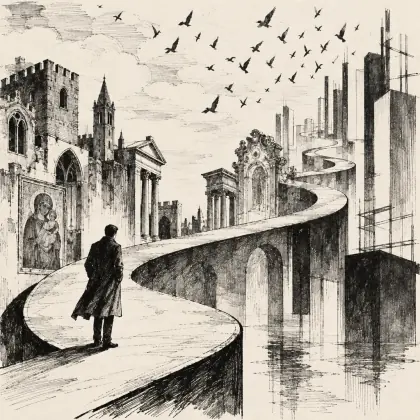
John Ashbery's poem tracks changing artistic fashions across centuries and the uneasy relation to modernity. It contrasts seeming versus being modern, traces influences moving between cultures, and notes how styles like baroque, classical, and modernism recur and are reinterpreted over time. The speaker urges accepting present tastes while anticipating modernism's arrival, portraying modernity as both isolating and identity-forming — a condition people adapt to rather than fully control.
Feel free to be first to leave comment.