
Biography of John Ashbery
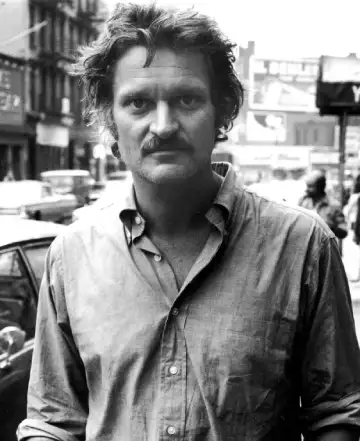
| date | place | |
|---|---|---|
| born | July 28, 1927 | New York, U.S. |
| died | September 03, 2017 | New York, U.S. |
John Lawrence Ashbery was born on July 28, 1927, in Rochester, New York, and became one of the most influential American poets of the late 20th and early 21st centuries. Over a career spanning more than six decades, he published over twenty collections of poetry and received virtually every major American literary award. His work is often associated with the New York School of poets, though his style ultimately transcended any single movement. Ashbery grew up on a fruit farm near Lake Ontario, an environment that shaped his early sensitivity to solitude, landscape, and interior life. As a child, he was deeply imaginative and began writing poetry at a young age. He attended Deerfield Academy, where he met fellow poet Frank O’Hara—an important early friendship. He studied at Harvard University, earning his bachelor’s degree in 1949. At Harvard, he became involved in literary circles and met poets such as Kenneth Koch and James Schuyler, who would later be linked with the New York School. After Harvard, he briefly attended Columbia University, completing a master’s degree. During this period, he began publishing poems in small magazines. In the mid-1950s, Ashbery moved to Paris, where he lived for nearly a decade. There he worked as an art critic for European editions of magazines such as Art News and the International Herald Tribune. His time in France deepened his engagement with modernist art and European avant-garde movements, which profoundly shaped his poetic development. Ashbery’s poetry resists easy summary. His early collection, Some Trees (1956), selected by W. H. Auden for the Yale Younger Poets Prize, already showed his interest in shifting perspectives and playful yet elusive language. His breakthrough came with Self-Portrait in a Convex Mirror (1975), inspired by a Renaissance painting by Parmigianino. This book won the Pulitzer Prize, the National Book Award, and the National Book Critics Circle Award—an extraordinary triple achievement. Stylistically, Ashbery’s poems often move associatively rather than logically. They mimic the flow of consciousness, blending high culture with everyday speech, philosophical reflection with casual observation. His lines frequently shift tone midstream, destabilizing expectations. Rather than offering a clear argument or narrative, his poems create a field of thought—fragmented, provisional, and constantly in motion. He was influenced by Surrealism, Abstract Expressionism, and modernist writers such as Wallace Stevens and Gertrude Stein. Yet his voice remains uniquely his own: ironic but not cynical, intellectual yet emotionally resonant, elusive yet strangely intimate. After returning to the United States in 1965, Ashbery settled in New York City and became deeply embedded in its artistic culture. He worked as an art critic and later taught at several universities, including Brooklyn College and Bard College. Ashbery was openly gay at a time when doing so was still risky in American public life. His sexuality informed aspects of his poetry, though rarely in direct or confessional ways. In 2010, he married his longtime partner, David Kermani. Throughout his life, Ashbery maintained a quiet but influential presence in literary circles. He avoided public drama and rarely explained his poems, often resisting critics’ attempts to impose definitive interpretations. Despite his international fame, he remained personally modest and somewhat private. John Ashbery reshaped American poetry by challenging the dominance of confessional and narrative styles in the mid-20th century. While poets such as Sylvia Plath and Robert Lowell foregrounded personal trauma and autobiography, Ashbery turned toward language itself—its instability, fluidity, and capacity to generate shifting realities. His influence on younger poets has been immense. Generations of writers adopted his openness to digression, tonal shifts, and intellectual play. He helped legitimize difficulty and ambiguity in contemporary American poetry without turning poetry into mere abstraction. Beyond literature, Ashbery bridged poetry and visual art. His deep involvement with painters and critics in New York made him a central cultural figure, connecting literary and visual avant-garde communities. By the late 20th century, he was widely regarded as America’s most important living poet. John Ashbery’s life traces a path from rural New York to the heart of the international avant-garde. He combined intellectual rigor with playful unpredictability, producing a body of work that expanded what American poetry could sound like and do. He died on September 3, 2017, at his home in Hudson, New York, at the age of 90. His death marked the end of an era in American poetry, but his influence continues to shape contemporary writing. Ashbery remains a poet of shifting mirrors—never fully graspable, always in motion, and permanently woven into the fabric of American literary history.
Feel free to be first to leave comment.