
A Worldly Country
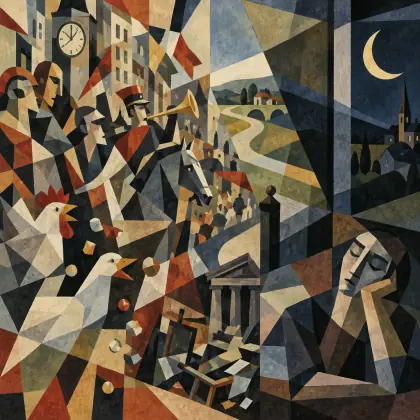
Not the smoothness, not the insane clocks on the square, the scent of manure in the municipal parterre, not the fabrics, the sullen mockery of Tweety Bird, not the fresh troops that needed freshening up. If it occurred in real time, it was OK, and if it was time in a novel that was OK too. From palace and hovel the great parade flooded avenue and byway and turnip fields became just another highway. Leftover bonbons were thrown to the chickens and geese, who squawked like the very dickens. There was no peace in the bathroom, none in the china closet or the banks, where no one came to make a deposit. In short all hell broke loose that wide afternoon. By evening all was calm again. A crescent moon hung in the sky like a parrot on its perch. Departing guests smiled and called, 'See you in church!' For night, as usual, knew what it was doing, providing sleep to offset the great ungluing that tomorrow again would surely bring. As I gazed at the quiet rubble, one thing puzzled me: What had happened, and why? One minute we were up to our necks in rebelliousness, and the next, peace had subdued the ranks of hellishness. So often it happens that the time we turn around in soon becomes the shoal our pathetic skiff will run aground in. And just as waves are anchored to the bottom of the sea we must reach the shallows before God cuts us free.
A Worldly Country - meaning Summary
Chaos Yielding to Ordinary Night
John Ashbery's "A Worldly Country" depicts a sudden, comic-violent eruption of everyday life—parades, animals, emptied banks—followed by an ordinary evening that restores calm. The speaker watches the flutter from puzzlement to resignation, noting how disruptive moments collapse back into routine. The closing metaphors—waves, shoals, God cutting us free—suggest a cyclical human tendency to press up against danger before being hauled back to safety, framing chaos as temporary and oddly inevitable.
Feel free to be first to leave comment.