
Biography of Matsuo Basho
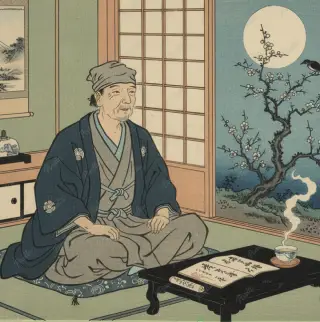
| date | place | |
|---|---|---|
| born | January 01, 1644 | Ueno, Japan |
| died | November 28, 1694 | Osaka, Japan |
Matsuo Bashō lived from 1644 to 1694, during Japan’s Edo period. He was born Matsuo Munefusa, with the childhood name Kinsaku, and later took the pen name “Bashō”, linked to the banana plant — an image that suited his taste for humble, natural beauty. He is most widely known today as the greatest master of haiku (in his lifetime, the form was usually discussed as hokku, the opening verse of a longer linked-verse poem). Bashō wasn’t just a writer of short poems: he was also a teacher, editor, and leader of a major poetic circle, shaping how poetry was written, judged, and lived. Bashō was born in or near Ueno in the old Iga Province (today part of Mie Prefecture). His family had samurai connections but not great wealth, and early on he served in a local warrior household. In his youth he became seriously involved in haikai — a lively, witty style of linked verse that was popular at the time. Eventually he moved to Edo (today Tokyo), where he built a reputation as an exceptional poet and mentor. A key turning point in his life was his growing sense that poetry should not be merely clever entertainment—it could become a disciplined way of seeing reality. That shift pushed him toward a life that mixed teaching, solitude, and long periods of travel. Bashō’s journeys were not “vacations” in the modern sense; travel in 17th-century Japan was physically hard and sometimes risky. But he treated travel as an artistic practice: walking through landscapes, visiting famous places tied to older literature, meeting people, and letting each encounter sharpen his attention. Over time, Bashō’s image became almost archetypal in Japanese culture: the poet as a wandering observer, living lightly, carrying only what he needed, turning moments into lasting lines. Bashō’s work sits at the center of several related forms. The most famous pieces associated with him are the short poems we now call haiku, but in his world the hokku was often the opening stanza of a collaborative chain of verses (linked verse). Bashō was deeply involved in that collaborative tradition: he wasn’t only writing “single perfect poems,” he was shaping the flow, tone, and standards of an entire poetic practice shared among groups. What makes Bashō’s poetry feel distinctive is the balance he achieved: simplicity without thinness, quiet emotion without melodrama, and clarity without losing mystery. His best poems often feel like they’re doing one small thing—showing an image, naming a season, catching a sound—yet they leave behind a larger aftertaste: impermanence, tenderness, loneliness, gratitude, awe. He is also famous for blending prose and verse in travel writing (a style often called haibun), especially in Oku no Hosomichi, where brief poems punctuate narrative like sudden flashes of concentrated seeing. Bashō’s cultural importance in Japan is hard to exaggerate. He helped transform a form that could be mainly playful or socially performative into something with serious artistic and spiritual depth. After Bashō, the short poem tradition was no longer just a clever pastime—it became a major lens through which Japanese readers and writers thought about perception, nature, time, and human feeling. He also set a standard of taste that later generations treated as foundational: attentiveness to the ordinary, respect for restraint, and the belief that the smallest moment—if truly seen—can carry the weight of a life. In that sense, Bashō shaped not only a poetic genre but a whole cultural attitude toward how meaning appears: not through grand speeches, but through precise, honest contact with the world. His routes and poem-locations became part of cultural memory, with places in Japan remembered partly through the lines he left behind, and his name became a reference point for what “real” haiku is supposed to feel like. Bashō died in 1694 at the age of 50, in Osaka. He had been traveling and staying with disciples, and his final weeks were shaped by illness (accounts commonly describe abdominal or digestive illness, but the exact medical cause isn’t known in modern terms). He was buried near a temple associated with another major figure in Japanese culture, and his death reinforced the image that already surrounded him: a poet whose life was inseparable from movement, simplicity, and the road—someone who kept walking, observing, and composing almost to the end.
Feel free to be first to leave comment.