
The Bee God
When you wanted bees I never dreamed It meant your Daddy had come up out of the well. I scoured the old hive, you painted it, White, with crimson hearts and flowers, and bluebird So you became the Abbess, In the nunnery of the bees. But when you put on your white regalia, Your veil, your gloves, I never guessed a wedding. That Maytime, in the orchard, that summer The hot, shivering chestnuts leaned towards us. Their great gloved hands again making their offer, I never know how to accept. But you bowed over your bees, As you bowed over your Daddy. Your page a dark swarm, Clinging under the lt blossom. You and your Daddy there in the heart of it, Weighing your slender neck. I saw I had given you something, That had carried you off in a cloud of gutturals. The thunderhead of your new selves, Tending your golden mane. You did not want me to go but your bees, Had their own ideas. You wanted the honey, you wanted those big blossoms, Clotted like first milk, and the fruit like babies. But the bees' orders were geometric, Your Daddy's plans were Prussian. When the first bee touched my hair, You were peering into the cave of thunder. That outrider tangled, struggled, stung- Marking the target. And I was flung like a headshot jackrabbit, Through sunlit whizzing tracers. As bees planted their volts, their thudding electrodes, In on their target. Your face wanted to save me, From what had been decided. You rushed to me, your dream-time veil off, Your ghost-proof gloves off. But as I stood there, where I thought I was safe, Clawing out of my hair. Sticky disembowelled bees, A lone bee liked a blind arrow. Soared over the housetop and down, And locked onto my brow, calling for helpers. Who came-- Fanatics for their god, the God of the bees. Deaf to your pleas as the fixed stars, At the bottom of the well.
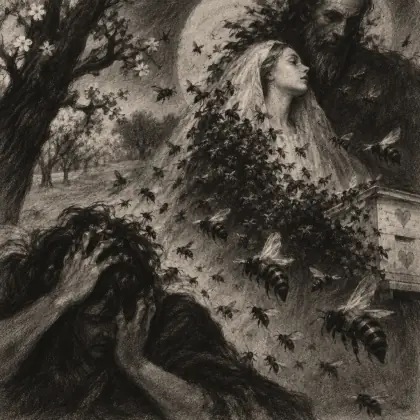
The Bee God - context Summary
A Beekeeping Memory Revisited
The Bee God appears in Ted Hughes's 1998 collection Birthday Letters, a sequence addressed to Sylvia Plath. It recalls a beekeeping episode during their marriage, but connects Plath's attraction to bees with the lasting presence of her dead father, Otto Plath, an entomologist. The poem belongs to Hughes's retrospective exploration of their relationship, grief, and the forces he felt lay beyond his control.
Feel free to be first to leave comment.