
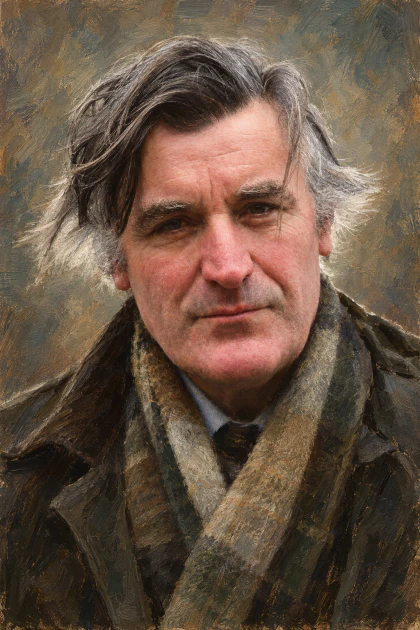
| date | place | |
|---|---|---|
| born | August 17, 1930 | Mytholmroyd, Yorkshire, England |
| died | October 28, 1998 | London, England |
Biography of Ted Hughes
Basic Information and Early Life Ted Hughes was an English poet, author and translator who became one of the most influential British poets of the 20th century. He was born Edward James Hughes on 17 August 1930 in Mytholmroyd, Yorkshire, England, and died on 28 October 1998, aged 68. Known for his powerful depictions of animals, nature, mythology and the darker aspects of human existence, Hughes developed a distinctive poetic style that combined vivid imagery with elemental, often unsettling energy. Hughes grew up in a family shaped by the landscapes of northern England. His father, William, had served in the First World War, while his mother, Edith, came from a family with deep roots in the region. When Hughes was seven, the family moved to Mexborough in South Yorkshire. The surrounding countryside, moors, rivers and wildlife became enduring influences on his imagination. From an early age, Hughes was fascinated by animals and the natural world. Rather than treating animals as decorative subjects, he portrayed them as powerful, independent forces with their own instincts and ways of existing. This fascination would become one of the defining characteristics of his poetry. After completing his national service in the Royal Air Force, Hughes attended Pembroke College, Cambridge, initially studying English before switching to archaeology and anthropology. His studies of mythology and ancient cultures helped shape his understanding of poetry as a way to explore the deeper forces underlying human life. Professional Work, Achievements and Important Trivia Hughes established his reputation with his first major collection, The Hawk in the Rain, published in 1957. The book won a poetry competition judged by Marianne Moore, W. H. Auden and Stephen Spender, bringing him immediate recognition. Its striking language and intense depictions of the natural world distinguished him from many of his contemporaries. His subsequent collections included Lupercal (1960), Wodwo (1967), Crow (1970), Cave Birds (1975), Remains of Elmet (1979), River (1983) and Birthday Letters (1998). Among his best-known poems are "The Thought-Fox," "Hawk Roosting," "Pike," "Wind" and "The Jaguar." These works demonstrate his ability to combine close observation with symbolic and mythological meaning. Nature remained central to Hughes's writing, but his animals often represented more than the creatures themselves. Hawks, foxes, crows and other animals became expressions of instinct, freedom, power and the struggle for survival. His language could be forceful and unsettling, presenting the natural world as something beautiful but indifferent to human comfort. Hughes also wrote extensively for children. His best-known children's book, The Iron Man (1968), tells the story of a mysterious metal giant who arrives on Earth. The book became a classic of children's literature and later inspired the animated film The Iron Giant (1999). Another important part of his career was translation. His Tales from Ovid (1997) reimagined stories from the Roman poet's Metamorphoses in vivid modern English. The book won the Whitbread Book of the Year award. In 1984, Hughes was appointed Poet Laureate of the United Kingdom, a position he held until his death. Shortly before his death, he was also appointed to the Order of Merit, one of Britain's highest honours. His final major collection, Birthday Letters (1998), explored his relationship with his first wife, the American poet Sylvia Plath. Published after decades of public speculation about their marriage, the book received major critical and popular attention and won both the Whitbread Book of the Year and the T. S. Eliot Prize for Poetry. Personal Life and Character Ted Hughes met Sylvia Plath at Cambridge in 1956, and they married that same year. Both would become major figures in modern poetry. They had two children, Frieda and Nicholas, and lived in the United States, London and Devon during their marriage. Their relationship ended in separation in 1962, and Plath died in 1963. Hughes's personal life remained a subject of intense public interest, particularly because of his connection to Plath and his role in managing her literary estate. He generally avoided discussing their relationship publicly for many years, preferring to keep his private life separate from his literary work. The publication of Birthday Letters offered his own poetic reflections on their relationship without resolving every question surrounding it. In 1970, Hughes married Carol Orchard, and they lived together in Devon for much of the rest of his life. He remained deeply connected to the countryside, especially through his interests in fishing, wildlife and environmental conservation. He supported efforts to protect rivers and wetlands and helped promote environmental awareness. Hughes was known for his intense commitment to writing and his fascination with mythology, psychology and the natural world. His interests extended beyond poetry into plays, essays, literary criticism and children's literature. He also supported creative writing education, helping to establish and develop initiatives that encouraged people to write. His personality and work could be forceful and uncompromising, but his writing also reveals tenderness, particularly in poems about family, memory and the landscapes of his childhood. This combination of intensity and sensitivity gives his poetry much of its distinctive character. Importance to British and English-Language Poetry Ted Hughes holds an important place in British literature and English-language poetry. His work challenged the restrained, often ironic style associated with some mid-20th-century poetry, offering instead a more visceral and imaginative engagement with nature, mythology and human experience. One of his major achievements was to make the natural world feel both immediate and symbolic. His poems often begin with a specific animal, landscape or physical event, then open into broader questions about power, violence, freedom and existence. In works such as "Hawk Roosting" and "The Thought-Fox," he demonstrated how vivid sensory description could coexist with psychological and mythological depth. Hughes also drew on the literary traditions of Britain and beyond, including classical mythology, folklore and Shakespeare. His poetry combines the textures of the English landscape with a wider interest in ancient stories and the forces that shape human behaviour. His influence extends beyond his own poems. Through his work for children, translations, essays and support for creative writing, Hughes helped broaden the ways poetry could reach readers. His environmental concerns also anticipated themes that have become increasingly important in contemporary literature. Although his public reputation was sometimes overshadowed by the story of his relationship with Sylvia Plath, his literary achievement stands on its own. Ted Hughes remains one of the defining British poets of the 20th century, celebrated for his originality, powerful language and distinctive vision of the relationship between humanity and the natural world. Death Ted Hughes died of cancer on 28 October 1998, aged 68. He left behind a substantial body of poetry, children's books, translations and essays, and his work continues to be widely read and studied as a major contribution to modern British literature.
Feel free to be first to leave comment.