
First, the Doubtful Charts of Skin
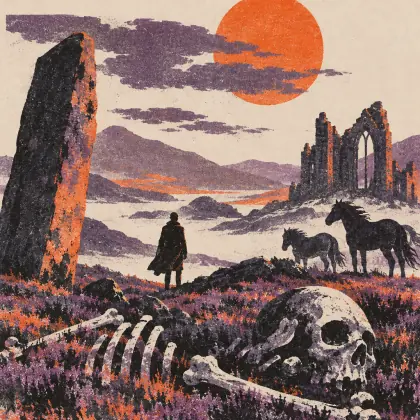
Came into my hands – I set out. After some harmless, irrelevant marvels And much boredom at sea Came the wrecked landfall, sharp rocks, hands and knees Then the small and large intestine, in their wet cave. These gave me pause. Then came the web of veins Where I hung so long For the giant spider’s pleasure, twitching in the darkest corner. Finally After the skull-hill of visions and the battle in the valley of screams After the islands of women I came to loose bones On a heathery moor, and a roofless church. Wild horses, with blowing tails and manes, Standing among graves. And a leaning menhir, with my name on it. And an epitaph, which read: ‘Under this rock, he found weapons.’
First, the Doubtful Charts of Skin - meaning Summary
Self-knowledge as Excavation
The poem presents exploration as an inward and increasingly perilous journey. Its speaker moves through a body imagined as strange terrain, then through visions, suffering, sexuality, burial places, and ruins. The final discovery of bones, graves, and a named stone turns the journey into an encounter with mortality. The epitaph suggests that self-knowledge yields not comfort but weapons: hard-won means of survival or struggle.
Feel free to be first to leave comment.