
February
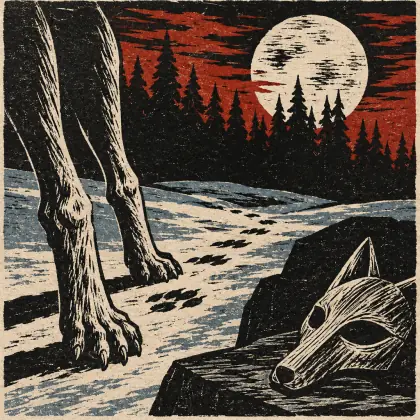
The wolf with its belly stitched full of big pebbles; Nibelung wolves barbed like black pineforest Against a red sky, over blue snow; or that long grin Above the tucked coverlet—none suffice. A photograph: the hairless, knuckled feet Of the last wolf killed in Britain spoiled him for wolves: The worst since has been so much mere Alsatian. Now it is the dream cries “Wolf!” where these feet Print the moonlit doorstep, or run and run Through the hush of parkland, bodiless, headless; With small seeming of inconvenience By day, too, pursue, seige all thought; Bring him to an abrupt poring stop Over engravings of gibbet-hung wolves, As at a cage where the scraggy Spanish wolf Danced, smiling, brown eyes doggily begging A ball to be thrown. These feet; deprived, Disdaining all that are caged, or storied, or pictured, Through and throughout the true world search For their vanished head, for the world Vanished with the head, the teeth, the quick eyes - Now, lest they choose his head, Under severe moons he sits making Wolf-masks, mouths clamped well onto the world.
February - meaning Summary
A Vanished Animal's Haunting Absence
The poem explores an obsessive attempt to recover the reality of the wolf after its disappearance from Britain. Images, stories, captive animals, and dreams cannot replace the living creature: they reduce it to a fragment or symbol. Confronted by a photograph of a dead wolf's feet, the speaker imagines those feet searching for their lost body and lost world. Making wolf masks becomes a defensive response to that haunting absence.
Feel free to be first to leave comment.