
Macaw and Little Miss
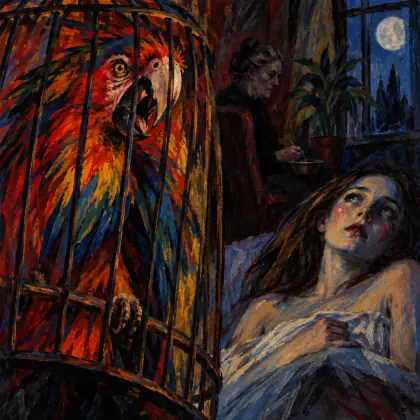
In a cage of wire-ribs The size of a man's head, the macaw bristles in a staring Combustion, suffers the stoking devils of his eyes. In the old lady's parlour, where an aspidistra succumbs To the musk of faded velvet, he hangs in clear flames, Like a torturer's iron instrument preparing With dense slow shudderings of greens, yellows, blues, Crimsoning into the barbs: Or like the smouldering head that hung In Killdevil's brass kitchen, in irons, who had been Volcano swearing to vomit the world away in black ash, And would, one day; or a fugitive aristocrat From some thunderous mythological hierarchy, caught By a little boy with a crust and a bent pin, Or snare of horsehair set for a song-thrush, And put in a cage to sing. The old lady who feeds him seeds Has a grand-daughter. The girl calls him 'Poor Polly', pokes fun. 'Jolly Mop.' But lies under every full moon, The spun glass of her body bared and so gleam-still Her brimming eyes do not tremble or spill The dream where the warrior comes, lightning and iron, Smashing and burning and rending towards her loin: Deep into her pillow her silence pleads. All day he stares at his furnace With eyes red-raw, but when she comes they close. 'Polly. Pretty Poll', she cajoles, and rocks him gently. She caresses, whispers kisses. The blue lids stay shut. She strikes the cage in a tantrum and swirls out: Instantly beak, wings, talons crash The bars in conflagration and frenzy, And his shriek shakes the house.
Macaw and Little Miss - meaning Summary
Captivity Beneath Domestic Calm
The poem places a fiercely expressive macaw in a cramped domestic cage and links its imprisoned violence to a young girl's private longings. To the old lady and her granddaughter, the bird is a pet called Polly, but the speaker imagines it as dangerous, mythic, and furious. Its final outburst exposes the pressure beneath polite household routines and the girl's silent, troubling dreams.
Feel free to be first to leave comment.