
Biography of Robert Lowell
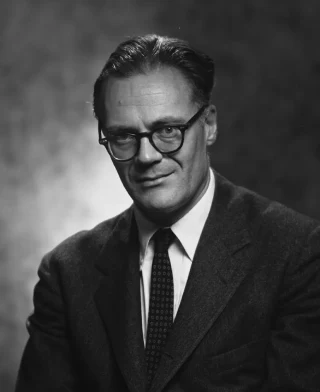
| date | place | |
|---|---|---|
| born | March 01, 1917 | Boston, Massachusetts, U.S |
| died | September 12, 1977 | New York City, U.S |
Robert Lowell (1917–1977) was one of the most influential American poets of the twentieth century and a central figure in the development of confessional poetry. Known for his intense, personal writing and formal mastery, Lowell transformed modern American poetry by bringing private experiences—mental illness, family conflict, marriage, politics, and faith—into the public literary sphere. His work earned numerous honors, including two Pulitzer Prizes for Poetry, and continues to be widely studied in universities across the United States. As a poet, translator, critic, and teacher, Robert Lowell shaped generations of writers. His collections Life Studies, For the Union Dead, and The Dolphin remain essential texts in American literature and are frequently cited among the most important poetry books of the twentieth century. Robert Traill Spence Lowell IV was born on March 1, 1917, in Boston into a prominent New England family with deep historical roots. His ancestors included military officers, politicians, and influential social figures, and he grew up surrounded by expectations of achievement and public service. Lowell attended St. Mark’s School before enrolling at Harvard University. However, he found the Harvard environment restrictive and eventually transferred to Kenyon College, where he studied under the poet and critic John Crowe Ransom. At Kenyon, Lowell developed the technical skills and literary discipline that would define his early work. His childhood was marked by tension between his parents and a feeling of emotional isolation. These experiences later became major subjects in his poetry, especially in Life Studies, where he portrayed his family with remarkable honesty and psychological depth. Robert Lowell’s professional career began with the publication of Land of Unlikeness in 1944, but he achieved national recognition with Lord Weary’s Castle (1946), which won the Pulitzer Prize for Poetry. The collection displayed his command of complex forms, religious imagery, and historical themes. During the 1950s, Lowell underwent a dramatic artistic transformation. Rejecting the dense, formal style of his early work, he published Life Studies in 1959. This groundbreaking collection introduced a more conversational voice and drew directly from his personal experiences, including mental illness, family history, and hospitalization. The book is widely considered one of the founding works of confessional poetry. His later collections expanded his reputation: For the Union Dead (1964) – a meditation on American history, race, and modern society. Near the Ocean (1967) – combining political commentary with lyrical reflection. Notebook (1969) – an experimental sequence of sonnet-like poems. The Dolphin (1973) – winner of Lowell’s second Pulitzer Prize for Poetry. Day by Day (1977) – his final collection, published shortly before his death. In addition to writing, Lowell taught at several prestigious institutions, including Boston University and Harvard University. Among his students were future major poets such as Sylvia Plath and Anne Sexton, both of whom became leading voices in confessional poetry. Robert Lowell’s personal life was as dramatic as his poetry. He was married three times: Jean Stafford (1940–1948), the novelist and short-story writer. Elizabeth Hardwick (1949–1972), an acclaimed critic and novelist with whom he had a daughter, Harriet. Caroline Blackwood (1972–1977), an Irish writer and aristocrat. His relationships were often turbulent and closely connected to his writing. One of the most controversial episodes of his career involved The Dolphin, which included passages adapted from private letters written by Elizabeth Hardwick during the collapse of their marriage. The decision sparked debate among writers and critics about privacy and artistic ethics. Lowell also struggled throughout his life with bipolar disorder (then often diagnosed as manic depression). He experienced repeated manic episodes that led to hospitalizations. Rather than hiding these experiences, he incorporated them into his poetry, helping to reduce the stigma surrounding mental illness in literature. Despite these challenges, Lowell enjoyed periods of great happiness. Friends and students often described him as intellectually generous, witty, and deeply engaged with contemporary politics. He was an outspoken opponent of the Vietnam War and participated in antiwar activism, even refusing an invitation to a White House arts festival in protest. Robert Lowell occupies a unique place in the history of American poetry. Before Lowell, much serious poetry remained relatively detached from the author’s private life. With Life Studies, he demonstrated that deeply personal material could become major art. Robert Lowell died on September 12, 1977, at the age of 60, from a heart attack while traveling in New York City. He was reportedly on his way to see Elizabeth Hardwick when he collapsed in a taxi. His death marked the end of one of the most influential careers in modern American literature, but his poetry remains a cornerstone of university study and continues to shape contemporary poets around the world.
Feel free to be first to leave comment.