
Archaic Torso of Apollo
We cannot fathom his mysterious head, Through the veiled eyes no flickering ray is sent: But from his torso gleaming light is shed As from a candelabrum; inward bent His glance there glows and lingers. Otherwise The round breast would not blind you with its grace, Nor could the soft-curved circle of the thighs Steal to the arc whence issues a new race. Nor could this stark and stunted stone display Vibrance beneath the shoulders heavy bar, Nor shine like fur upon a beast of prey, Nor break forth from its lines like a great star— There is no spot that does not bind you fast And transport you back, back to a far past.
Translated by Jessie Lamont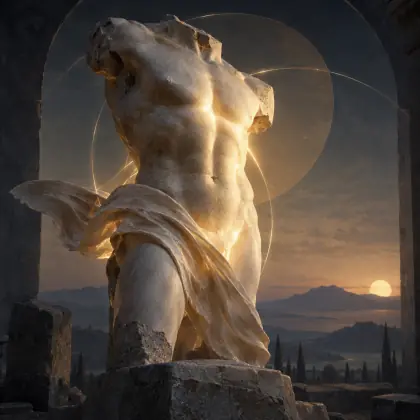
Archaic Torso of Apollo - context Summary
Composed in Paris, 1908
Written while Rilke lived in Paris and published in New Poems (1908), the poem responds to seeing an ancient, fragmentary statue. Rilke treats the torso as a stimulus that radiates inner light and summons the viewer into a deep, almost spiritual encounter. The damaged sculpture becomes a source of life, memory, and transformation, suggesting art’s power to awaken inward vision and transport one toward a distant past.
Feel free to be first to leave comment.