
The Panther
His weary glance, from passing by the bars, Has grown into a dazed and vacant stare; It seems to him there are a thousand bars And out beyond those bars the empty air. The pad of his strong feet, that ceaseless sound Of supple tread behind the iron bands, Is like a dance of strength circling around, While in the circle, stunned, a great will stands. But there are times the pupils of his eyes Dilate, the strong limbs stand alert, apart, Tense with the flood of visions that arise Only to sink and die within his heart.
Translated by Jessie Lamont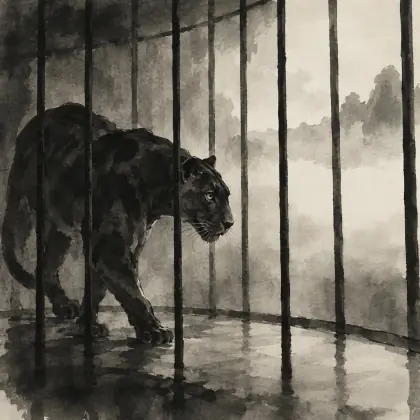
The Panther - context Summary
Composed in Paris, 1902
Rilke’s "The Panther" depicts a caged animal whose repetitive pacing and glazed stare convey spiritual and psychological confinement. The poem contrasts mechanical, mesmerizing movement with rare, intense moments when the animal’s vision briefly clears, only for those impressions to vanish. Its spare, observational voice turns the panther into a symbol of trapped vitality and thwarted will. The poem appears in The Book of Images, published 1902, written during Rilke’s Paris years.
Feel free to be first to leave comment.