
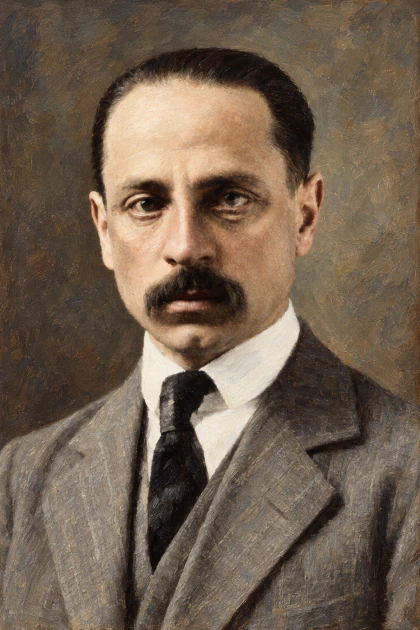
| date | place | |
|---|---|---|
| born | December 04, 1875 | Prague, Bohemia, Austria-Hungary |
| died | December 29, 1926 | Montreux, Switzerland |
Biography of Rainer Maria Rilke
Rainer Maria Rilke was born in 1875 in Prague, then part of the Austro-Hungarian Empire. His childhood was emotionally difficult: he was highly sensitive, raised by a possessive mother, and placed in military academies that he experienced as traumatic. These early tensions fostered his lifelong inwardness and his conviction that true life unfolds within solitude. Rilke later studied literature, philosophy, and art history in Prague, Munich, and Berlin, but he never adapted to conventional academic or professional life. A decisive influence on both his personal and artistic development was his relationship with Lou Andreas-Salomé, who encouraged intellectual rigor, self-discipline, and independence. Rilke married the sculptor Clara Westhoff in 1901, but the marriage soon became distant; he spent most of his adult life traveling, living in rented rooms, castles, and retreats across Europe, often supported by patrons. His time in Paris, including a period working as secretary to Auguste Rodin, was harsh yet formative, teaching him precision, patience, and attention—qualities that reshaped his poetry. Rilke died in 1926 in Switzerland from leukemia, after completing the works that would secure his reputation as one of the major poets of the modern era. Rilke wrote in German and is best described as a lyric and philosophical poet, standing at the crossroads between late Romanticism and literary modernism. Early influences included Goethe, German Romantic poetry, and French Symbolism, but his mature voice is entirely his own. His poetry is marked by intense inward reflection, spiritual searching, and a deep concern with mortality, love, transformation, and art itself. His most influential works, The Duino Elegies and Sonnets to Orpheus, are considered among the greatest poetic achievements of the twentieth century. Rilke rejected political or social poetry in favor of an existential vision in which art becomes a means of confronting fear, loss, and impermanence. In the United States, Rilke occupies a unique place: he is one of the most widely translated European poets, frequently taught in American universities, and deeply influential on poets, writers, and thinkers. His Letters to a Young Poet remains a foundational text for aspiring writers, shaping how generations of American readers understand creativity, solitude, and artistic discipline. Rainer Maria Rilke is remembered as a poet of interior depth and spiritual seriousness, whose work invites readers to face existence with patience, attentiveness, and courage. His poetry does not offer easy answers; instead, it teaches how to live with uncertainty and transform inner experience into lasting art.
Feel free to be first to leave comment.