
The Book of Poverty and Death
Her mouth is like the mouth of a fine bust That cannot utter sound, nor breathe, nor kiss, But that had once from Life received all this Which shaped its subtle curves, and ever must From fullness of past knowledge dwell alone, A thing apart, a parable in stone. Alone Thou wanderest through space, Profound One with the hidden face; Thou art Poverty's great rose, The eternal metamorphose Of gold into the light of sun. Thou art the mystic homeless One; Into the world Thou never came, Too mighty Thou, too great to name; Voice of the storm, Song that the wild wind sings, Thou Harp that shatters those who play Thy strings! A watcher of Thy spaces make me, Make me a listener at Thy stone, Give to me vision and then wake me Upon Thy oceans all alone. Thy rivers' courses let me follow Where they leap the crags in their flight And where at dusk in caverns hollow They croon to music of the night. Send me far into Thy barren land Where the snow clouds the wild wind drives, Where monasteries like gray shrouds stand— August symbols of unlived lives. There pilgrims climb slowly one by one, And behind them a blind man goes: With him I will walk till day is done Up the pathway that no one knows ...
Translated by Jessie Lamont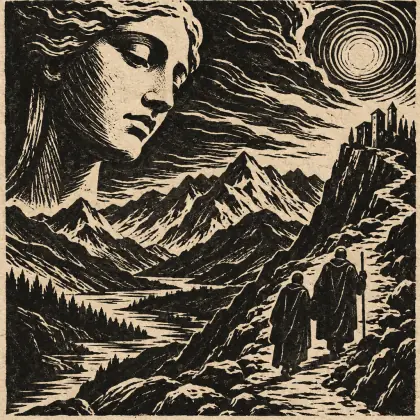
The Book of Poverty and Death - meaning Summary
Mystical Yearning and Solitude
The poem presents a distant, statue-like beloved and a solitary, mystical speaker who seeks union with an overwhelming, unnamed presence. It contrasts static, memory-filled forms with dynamic natural journeys — rivers, storms, barren lands — as metaphors for spiritual pursuit. The narrator asks to be made watcher and listener, to follow pilgrimage and hardship toward an inaccessible center. The closing image of walking with a blind man emphasizes faith, devotion, and the unknown path.
Feel free to be first to leave comment.